
Specialist evidence-based therapy for trauma and PTSD that helps people process distressing experiences, make sense of the meanings attached to them and reconnect with life in the present.
Trauma can continue to affect people long after an experience itself has ended. Memories may feel vivid or intrusive, the body may remain alert to danger, situations associated with what happened can become difficult to approach, and beliefs such as “It was my fault,” “I’m not safe,” “I should have done something differently” or “I can’t trust anyone” can become deeply embedded.
Trauma-Focused Cognitive Behavioural Therapy (TF-CBT) is an evidence-based psychological approach that helps people understand why these responses develop and what may be keeping the experience feeling emotionally present.
Rather than simply talking about what happened or trying to replace difficult thoughts with positive ones, trauma-focused CBT works with trauma memories, their meanings, patterns of avoidance and the ways people have understandably learned to protect themselves following overwhelming experiences.
At Food For Thought Therapy, trauma-focused work is collaborative and guided by an individual formulation. The aim isn’t to erase what happened or force someone to “move on”. It is to help the past become more fully recognised as the past, whilst developing greater freedom in how people understand themselves and live in the present.
What Is Trauma-Focused CBT?
Following trauma, the mind and body can continue responding as though danger remains close. A memory may be triggered unexpectedly, certain situations can feel unsafe, or someone may intellectually know that an experience wasn’t their fault whilst emotionally continuing to feel responsible.
People may find themselves:
- Experiencing intrusive memories, nightmares or flashbacks.
- Avoiding people, places, conversations or reminders of what happened.
- Feeling constantly alert to possible danger.
- Blaming themselves for what happened or how they responded.
- Replaying events and wondering what they should have done differently.
- Feeling disconnected, numb or emotionally overwhelmed.
- Struggling to trust themselves or other people.
- Holding beliefs such as “I’m unsafe,” “I’m powerless” or “something is wrong with me.”
- Finding that experiences from the past continue to shape relationships, choices or everyday life.
These responses often make sense in the context of what someone has experienced. Trauma-focused CBT helps us understand how memories, meanings, emotions and protective responses have become connected, and what may be preventing the brain from recognising fully that the circumstances of the present are different from those of the past.
The aim isn’t to tell people that their fears are irrational. It is to understand what happened, what was learned through that experience and whether those conclusions still need to shape life today.
What Happens During Trauma-Focused CBT?
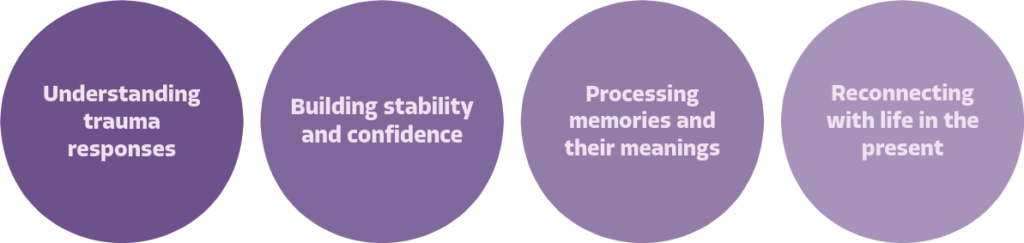
What Can Trauma-Focused CBT Help With?
Trauma-focused CBT is most strongly associated with the treatment of Post-Traumatic Stress Disorder (PTSD) and trauma-related symptoms. Within my practice, trauma-focused CBT may be considered where people are experiencing difficulties such as:
- PTSD following a single traumatic event.
- Trauma following accidents, illness or medical experiences.
- Experiences of violence, assault or abuse.
- Traumatic bereavement.
- Birth-related trauma.
- Childhood or developmental trauma.
- Repeated or interpersonal trauma.
- Intrusive memories, nightmares or flashbacks.
- Trauma-related guilt, shame or self-blame.
- Avoidance and heightened threat following distressing experiences.
The Evidence Behind Trauma-Focused CBT
Trauma-focused CBT approaches are among the best-established psychological treatments for PTSD and are recommended within clinical guidelines for people experiencing post-traumatic stress symptoms.
The approach recognises that recovery often involves more than trying to reduce anxiety. Trauma can affect memory, beliefs, emotions, relationships and someone’s sense of safety or responsibility, so therapy works with the particular ways an experience continues to influence life in the present.
For some people, this means working with memories that still feel immediate or fragmented. For others, the most painful part may be the meaning attached to what happened, such as self-blame, guilt, shame, loss of trust or a belief that the world can no longer be safe.
Treatment is therefore guided by an individual formulation rather than assuming that everyone who has experienced trauma needs exactly the same work.
Food For Thought
Trauma can leave people living not only with what happened, but with what they came to believe because it happened. What might change if those conclusions no longer had to define the present?
A Note from Agi
One of the things I think is particularly important in trauma therapy is recognising that people’s responses usually make sense in the context of what they have experienced. Avoidance, hypervigilance, emotional detachment or constantly anticipating danger may have developed for very understandable reasons.
People can also become caught in painful loops of “I should have known,” “I should have stopped it,” “Why didn’t I do something differently?” or “It was my fault.” Sometimes these conclusions continue to feel emotionally true even when another part of the person can recognise that they are judging their past self with information, choices or perspective that simply weren’t available at the time.
Trauma-focused CBT gives us space to understand both what happened and what the experience came to mean. The aim isn’t to rewrite history, minimise what someone went through or convince them to think positively. It is to help memories and meanings become more integrated, whilst recognising when responses that made sense then may no longer need to organise life now.
For me, effective trauma therapy holds compassion and change together: respecting the ways someone learned to survive whilst creating opportunities to discover that the present may allow for different possibilities.
Frequently Asked Questions
Is Trauma-Focused CBT different from ordinary CBT?
Yes. Trauma-focused CBT uses principles from Cognitive Behavioural Therapy but applies them specifically to the processes that can maintain PTSD and trauma-related difficulties.
Rather than simply challenging negative thoughts, therapy may work directly with trauma memories, avoidance, heightened threat and meanings involving safety, responsibility, guilt or shame.
Will I have to talk about everything that happened?
Trauma-focused therapy usually involves some work with the experiences connected to current difficulties, but this doesn’t mean having to disclose every detail immediately or repeatedly recounting traumatic experiences without purpose.
We begin by developing a shared formulation and preparing for the work. What we focus on, why we are focusing on it and how we approach it are discussed collaboratively.
Will talking about trauma make things worse?
It is understandable to worry that approaching difficult memories will feel overwhelming. Trauma-focused work can bring up difficult emotions, which is why preparation, pacing and a strong therapeutic relationship matter.
The aim isn’t to create as much distress as possible. We work within a clear therapeutic framework so that approaching memories creates opportunities for processing and new learning rather than simply repeating the experience.
What if I know something wasn’t my fault but still feel that it was?
This is very common following trauma. Knowing something intellectually and experiencing it as emotionally true are not always the same thing.
Traumatic experiences can become strongly connected with the brain and nervous system’s memory, emotion and threat responses. This can help explain why someone may genuinely know “It wasn’t my fault” or “I’m safe now”, whilst emotionally or physically experiencing something very different.
Trauma-Focused CBT helps work with this gap by exploring guilt, responsibility, hindsight and the meanings attached to the memory, allowing new information and perspectives to become more fully integrated rather than simply understood intellectually.
What if I can’t remember everything clearly?
Traumatic memories aren’t always experienced as a clear chronological narrative. Some parts may feel exceptionally vivid whilst others are fragmented, uncertain or difficult to recall.
Therapy doesn’t require a perfect memory of everything that happened. We work with what is available and, importantly, how the experience continues to affect someone now, without trying to manufacture certainty about details that cannot be known.
Is Trauma-Focused CBT suitable for complex trauma?
It can be. People who have experienced repeated, developmental or interpersonal trauma may have difficulties extending beyond intrusive memories and avoidance, including shame, emotional regulation, relationships, identity or longstanding beliefs about themselves.
Where appropriate, trauma-focused CBT can therefore sit within a broader formulation, and therapy may thoughtfully draw on approaches such as EMDR, Schema Therapy, Compassion Focused Therapy or ACT where these address important aspects of someone’s difficulties.
Integration doesn’t mean using everything at once. The formulation guides what we use, when and why.
What is the difference between Trauma-Focused CBT and EMDR?
Both are evidence-based psychological treatments used for PTSD, but they approach trauma processing differently.
Trauma-focused CBT typically involves understanding and working with trauma memories, their meanings, avoidance and patterns of thinking or behaviour that continue to maintain a sense of current threat. EMDR uses bilateral stimulation alongside a structured processing protocol to help distressing memories become more adaptively integrated.
Neither approach is automatically better for everyone. Assessment gives us an opportunity to consider the person’s experiences, preferences, needs and formulation when deciding which approach may be most appropriate.
Is Trauma-Focused CBT only for PTSD?
Not necessarily. Trauma-focused principles may sometimes be useful when past experiences continue to contribute to current difficulties even where someone does not meet full diagnostic criteria for PTSD.
However, experiencing something difficult or painful doesn’t automatically mean that trauma processing is needed. Assessment helps establish what is maintaining the current difficulty and whether working directly with trauma is likely to be helpful.
How many sessions will I need?
There isn’t one number that is right for everyone. The length of trauma-focused CBT depends on factors including the nature of the experiences, current symptoms, treatment goals, complexity and whether other difficulties also need attention.
Some people benefit from a relatively focused course of trauma therapy, whilst repeated or more complex experiences may require longer. We agree the initial plan together and review progress throughout rather than assuming a fixed number of sessions will suit everyone.
Can Trauma-Focused CBT be delivered online?
Yes. Trauma-focused CBT can be delivered online as well as face-to-face, where this is clinically appropriate.
I offer online therapy across the UK alongside in-person appointments in Menai Bridge, Isle of Anglesey, and Llandudno, Conwy, North Wales. We can discuss individual needs and preferences when considering the most appropriate format.
How Do We Start?
If you’re considering Trauma-Focused CBT and would like to explore whether it may be the right approach for you, you’re welcome to book a free 15-minute discovery call.
We can briefly discuss what has brought you to therapy, how past experiences may be affecting life now and whether Trauma-Focused CBT, or another approach such as EMDR, is likely to be a good fit.
If we decide to work together, the first sessions provide more space to develop a shared formulation, understand what is keeping the difficulties going and agree how therapy can move forward safely and purposefully.
You don’t need to know whether you have PTSD or decide between Trauma-Focused CBT and EMDR before getting in touch. We can begin by understanding your experience and decide together what is most likely to help.