
Evidence-based therapy that helps you understand lifelong patterns, meet unmet emotional needs and create lasting change.
Schema Therapy is an integrative, evidence-based psychological therapy that combines Cognitive Behavioural Therapy (CBT), attachment theory, developmental psychology, emotion-focused approaches and experiential techniques to help us understand longstanding emotional patterns.
Many of the ways we think, feel and respond today developed for understandable reasons. They often began as adaptations to early experiences, relationships or environments where important emotional needs were not fully met. Although these patterns may once have helped us cope, they can continue to influence our relationships, emotions and sense of self long after they are no longer serving us.
At Food For Thought Therapy, Schema Therapy isn’t about blaming the past or blaming parents. It is about making sense of how your experiences have shaped the way you relate to yourself, other people and the world around you. By understanding these patterns with compassion rather than criticism, we can begin creating new experiences that support healthier, more flexible ways of living.
Understanding Schema Therapy
Every one of us develops patterns throughout life. Some help us thrive. Others become increasingly restrictive.
Perhaps you find yourself constantly putting other people’s needs first, even when it leaves you exhausted. Perhaps you expect rejection, struggle to trust others, feel responsible for everyone’s wellbeing or believe you are never quite “good enough”, no matter how much you achieve. These patterns rarely appear without reason.
Schema Therapy understands them as understandable adaptations that developed in response to our early environments and significant life experiences. Rather than asking, “What’s wrong with me?“, it asks a different question: “What happened that made this pattern make sense?”
Schemas are deeply held beliefs and emotional patterns that influence how we interpret ourselves, other people and the world. Because they often operate automatically, they can continue shaping our lives without us fully realising they are there.
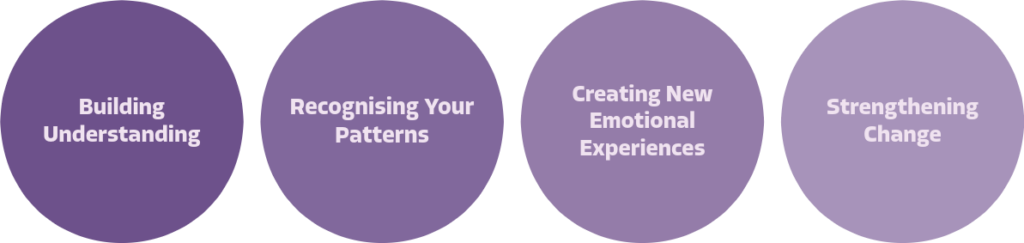
The aim of Schema Therapy is not to erase these parts of you. It is to understand how they developed, recognise when they are influencing the present and gradually create new emotional experiences that allow healthier patterns to emerge.
What Happens During Schema Therapy?
What Can Schema Therapy Help With?
Schema Therapy may be particularly helpful if you notice patterns that seem to repeat throughout your life or relationships. It is commonly used to support people experiencing:
- Chronic Low Self-Esteem
- Complex Trauma (CPTSD)
- Personality Difficulties
- Relationship Difficulties
- Perfectionism
- Longstanding Anxiety or Depression
- Emotional Dysregulation
The Evidence Behind Schema Therapy
Schema Therapy was developed for longstanding or recurring psychological difficulties, particularly when familiar patterns continue despite insight, previous therapy or efforts to change. It is used across a range of difficulties, including chronic depression, complex trauma, eating disorders and longstanding emotional or relationship patterns.
Rather than focusing only on current symptoms, Schema Therapy explores how deeper patterns developed, why they continue to feel so powerful and what keeps them going today. It combines cognitive, behavioural, emotional and relational work to help people not only understand these patterns, but begin responding to them differently.
Schema Therapy can be longer-term than more focused CBT approaches, particularly when patterns have developed over many years. The aim is to create meaningful and lasting change in how people understand themselves, meet their emotional needs and relate to others.
Food For Thought
A pattern can make perfect sense in the context in which it developed and still make life harder today. Understanding where it came from gives us the opportunity to decide whether it still needs to lead the way.
A Note from Agi
One of the reasons I value Schema Therapy is that it can help people make sense of themselves with greater compassion, without losing sight of the possibility for change. People often arrive in therapy carrying long-standing conclusions such as “I’m too sensitive,” “I’m too much,” “I’m not enough,” or “there’s something fundamentally wrong with me.” When those beliefs have been present for a long time, they can begin to feel less like beliefs and more like facts about who someone is.
Schema Therapy gives us space to become curious about where those patterns came from, what emotional needs may not have been met and how different ways of coping developed in response. What now looks like avoidance, perfectionism, emotional detachment, people-pleasing or relentless self-criticism may make much more sense when understood within the context in which it developed.
Understanding doesn’t mean excusing everything, blaming the past or assuming that every coping strategy was helpful. It means recognising that patterns have a history and a function, whilst also noticing when they are no longer serving the person in the same way.
For me, some of the most meaningful Schema Therapy work happens when people begin to recognise that a familiar pattern isn’t necessarily who they are. Therapy can create space to understand and respond differently to the parts of ourselves that feel frightened, critical, demanding, vulnerable or protective, whilst gradually strengthening ways of relating to ourselves and others that feel more flexible, connected and authentic.
Frequently Asked Questions
What is Schema Therapy?
Schema Therapy is an integrative, evidence-based psychological therapy that combines Cognitive Behavioural Therapy (CBT), attachment theory, developmental psychology and experiential approaches. It is designed to help people understand and change longstanding emotional patterns, particularly when difficulties have been present for many years or keep recurring despite previous therapy.
Rather than focusing only on current symptoms, Schema Therapy explores the deeper patterns that may be influencing how you think, feel, relate to others and respond to life’s challenges.
How is Schema Therapy different from CBT?
Both Schema Therapy and CBT are evidence-based approaches, but they have different areas of focus.
CBT often concentrates on the thoughts, behaviours and maintaining cycles that are contributing to current difficulties. Schema Therapy looks more deeply at the longstanding emotional patterns and unmet needs that may have shaped those cycles over time.
Many people find the approaches complement one another, and I often integrate elements of both depending on your individual formulation and goals.
What are schemas?
Schemas are deeply held patterns of thinking, feeling and relating that develop through our life experiences. They influence how we see ourselves, other people and the world around us.
Everyone develops schemas. Some are helpful and supportive, while others may become restrictive or self-defeating over time. Therapy helps us recognise these patterns, understand how they developed and create opportunities for healthier ways of responding.
What are schema modes?
Schema modes are the different emotional “states” or “parts” of ourselves that become activated in different situations.
For example, you may notice a part of yourself that becomes highly self-critical, another that withdraws when relationships feel unsafe, or another that strives for perfection to avoid failure. Rather than seeing these as flaws, Schema Therapy helps us understand the function they have served and strengthen the Healthy Adult mode that can respond with greater flexibility and compassion.
Do I have to talk about my childhood?
Not necessarily.
Although early experiences are often explored because they help us understand how patterns developed, Schema Therapy is not about analysing childhood for its own sake or blaming parents or caregivers.
The focus is always on understanding the present. We explore earlier experiences only when they help explain patterns that continue to affect your life today.
How long does Schema Therapy usually take?
Schema Therapy is often a longer-term approach than standard CBT because it focuses on changing deeply established emotional patterns rather than simply reducing symptoms.
The length of therapy varies depending on your goals, the nature of your difficulties and whether Schema Therapy is being used on its own or integrated with other approaches. We’ll review progress regularly and make collaborative decisions about the pace and direction of therapy.
Can Schema Therapy help if I’ve had therapy before?
Yes.
Many people seek Schema Therapy because they understand their difficulties intellectually but continue to notice the same emotional patterns repeating in relationships, work or their sense of self.
Schema Therapy can be particularly helpful when previous therapy has reduced symptoms but hasn’t fully addressed the deeper patterns that continue to leave you feeling stuck.
Is Schema Therapy suitable for complex trauma?
Yes.
Schema Therapy has a growing evidence base for complex trauma and is particularly helpful where earlier experiences continue to influence relationships, emotional regulation, self-worth or the way you see yourself.
Depending on your needs, Schema Therapy may also be integrated with approaches such as EMDR to support both trauma processing and longer-term pattern change.
Can Schema Therapy be combined with other therapies?
Absolutely.
Depending on your formulation, Schema Therapy can be thoughtfully integrated with Cognitive Behavioural Therapy (CBT), EMDR, Acceptance and Commitment Therapy (ACT) and Compassion Focused Therapy (CFT).
The aim is not to combine therapies unnecessarily, but to draw on the most appropriate evidence-based approaches for your individual needs.
Is Schema Therapy neurodiversity-affirming?
Yes.
My practice is proudly neurodiversity-affirming. Therapy recognises that autism, ADHD, sensory differences, communication styles and executive functioning can all influence how emotional patterns develop and how therapy is experienced.
Schema Therapy is adapted to work with your neurotype rather than expecting you to fit a standard model. The focus is on understanding your experiences within the context of your life, strengths and support needs.
Is Schema Therapy LGBTQIA+ affirming?
Absolutely.
I strive to provide an inclusive, affirming and respectful therapeutic space for people of all sexual orientations, gender identities and relationship structures.
Schema Therapy explores the impact of relationships, identity and life experiences without viewing diversity as something that needs to be changed. Therapy is grounded in compassion, collaboration and evidence-based practice while recognising the wider social and cultural contexts that shape our experiences.
Can Schema Therapy be delivered online?
Yes. I offer Schema Therapy online across the UK, alongside in-person appointments in Menai Bridge and Llandudno, North Wales.
Many of the cognitive, experiential and imagery-based techniques used in Schema Therapy adapt very well to online work, allowing therapy to remain engaging and effective wherever you choose to access support.
I understand where my patterns come from, why do they still feel so difficult to change?
This is one of the most common questions I hear.
Understanding is an important first step because it helps us make sense of our experiences and reduces self-blame. However, many emotional patterns developed over years, sometimes decades, and are deeply connected to the way our brains and nervous systems learned to keep us safe.
Insight alone rarely changes these patterns.
Schema Therapy combines understanding with new emotional and behavioural experiences, allowing change to happen not only intellectually but also emotionally. Over time, these new experiences help strengthen healthier patterns and create greater flexibility in the way you relate to yourself and others.
What if I’m worried that therapy will make me blame my parents?
This is a common concern, and one that many people feel uneasy about before starting therapy.
Schema Therapy is not about assigning blame or deciding that anyone was a “good” or “bad” parent. Most parents do the best they can with the resources, knowledge and experiences available to them. At the same time, even loving and well-intentioned relationships can leave important emotional needs unmet.
The aim of therapy is not to criticise the people in your life. It is to understand how your experiences have shaped you so that you have greater freedom in how you respond today. Understanding the origins of a pattern allows us to move forward with greater compassion, for yourself and, often, for others too.
Will Schema Therapy change who I am?
No.
One of the biggest misconceptions about Schema Therapy is that it tries to change your personality. In reality, the aim is almost the opposite.
Many of the patterns we explore developed as ways of adapting to difficult experiences. They often helped you survive, protect yourself or maintain important relationships. Therapy isn’t about getting rid of those parts of you or becoming someone different.
It’s about helping you understand those patterns with compassion, recognise when they are no longer serving you and develop greater flexibility in how you respond. Most people don’t feel like they become a different person through Schema Therapy, they often describe feeling more like themselves, with greater freedom to live in line with their values rather than old survival strategies.
How Do We Start?
If you’re considering Schema Therapy and would like to explore whether it may be the right approach for you, you’re welcome to book a free 15-minute discovery call or arrange an initial assessment.
Together, we’ll develop a shared understanding of your experiences, identify the patterns that seem to be keeping you stuck, and consider whether Schema Therapy or another evidence-based approach is most likely to help you move towards the life you want to live.
Whether you’re experiencing complex trauma, longstanding anxiety or depression, perfectionism, relationship difficulties, low self-esteem or recurring emotional patterns, therapy begins by making sense of your experiences before creating opportunities for meaningful, lasting change.