
Evidence-based, trauma-informed therapy to help you understand how difficult experiences continue to affect you, process what happened and reconnect with life beyond survival.
Trauma is often associated with catastrophic events, but people’s experiences of trauma are much more varied. It can follow a single overwhelming event, repeated experiences over time, difficult relationships, loss, medical experiences or circumstances in which safety, choice or control felt compromised.
What happened matters, but so does what your mind and nervous system learned as a result. Experiences can shape how we respond to threat, how safe we feel with other people, what we believe about ourselves and what happens when something in the present reminds us, consciously or unconsciously, of the past.
Some people experience recognisable symptoms of Post Traumatic Stress Disorder (PTSD), such as intrusive memories, nightmares, avoidance and feeling constantly alert to danger. Others notice difficulties with emotions, relationships, shame, trust, disconnection or a sense that their body reacts before their mind has understood why.
Trauma responses aren’t signs of weakness or evidence that somebody has failed to “move on”. They develop and continue for reasons. At the same time, understanding why they developed is rarely enough on its own. Recovery also involves helping the mind and nervous system update what they learned when those responses first became necessary.
Therapy begins by understanding your individual experience: what happened, what continues to affect you now and what greater freedom might look like, before identifying the evidence-based approaches most likely to help.
Understanding Trauma
Trauma isn’t simply another word for something painful or upsetting. Many difficult experiences are distressing without leading to traumatic stress, whilst experiences that appear manageable from the outside can sometimes have a profound impact on the person who lived through them.
When something overwhelms our ability to process what is happening, aspects of the experience can remain emotionally and physiologically present even after the event itself has ended.
A memory may feel unusually vivid or fragmented. A sound, smell, expression, bodily sensation or situation can suddenly trigger fear, shame, anger or helplessness. Sometimes there isn’t an obvious memory at all, the body seems to react before the conscious mind understands why. The mind may begin asking:

Trauma isn’t only about fear. Experiences can become connected with shame, guilt, responsibility, anger, disgust, grief, helplessness or beliefs about who we are. Someone may know intellectually, “It wasn’t my fault,” whilst another part of them continues to feel responsible. They may know that they are safe now whilst their body continues preparing for danger.
People can also respond in very different ways. One person may avoid talking about what happened whilst another talks about it repeatedly. Someone may become highly independent and self-reliant, whilst another seeks closeness or reassurance. One person may fight or become angry; another may freeze, appease, withdraw or emotionally shut down.
Different responses can develop around the same underlying need for safety, protection or survival. Effective trauma therapy therefore looks beyond the behaviour itself. We first understand what the response learned to do, why it made sense and whether it is still protecting you now or keeping the past influential in the present.
How Trauma Can Affect Everyday Life
Trauma can affect almost every area of life, and much of its impact may be invisible to other people. Someone can appear to be functioning extremely well whilst internally remaining alert to danger, managing intrusive memories or working hard to avoid situations that feel unsafe. People might notice:
- Re-experiencing, including intrusive memories, images, nightmares or emotional flashbacks.
- Avoiding, staying away from places, conversations, people, sensations or memories connected with what happened.
- Monitoring, watching other people’s moods, the environment or their own body for signs that something is wrong.
- Preparing, thinking ahead, planning escape routes or anticipating what might happen if something goes wrong.
- Disconnecting, feeling numb, detached, unreal or emotionally shut down.
- Freezing or appeasing, finding it difficult to respond, say no, disagree or recognise what you need in the moment.
- Controlling, trying to make situations predictable enough to feel safe.
- Withdrawing, keeping distance from relationships or vulnerability to reduce the possibility of being hurt.
- Experiencing shame or self-blame, repeatedly questioning what you did, didn’t do or “should” have done differently.
- Struggling with closeness, wanting connection whilst simultaneously finding vulnerability difficult or unsafe.
Trauma can also affect sleep, concentration, work, intimacy, parenting, confidence and someone’s relationship with their own body.
For some people, the most difficult responses appear when circumstances are objectively calm. Resting may feel uncomfortable, safety unfamiliar or closeness surprisingly threatening because the nervous system has become accustomed to remaining prepared.
Trauma responses don’t have to look dramatic from the outside to take up an enormous amount of space internally.
What Keeps Trauma Difficulties Going?
Trauma responses often begin as attempts to protect us. The difficulty is that strategies learned around past danger can continue operating when circumstances have changed, particularly when the memory has not fully updated with information about what is different now. This can create a reinforcing cycle:
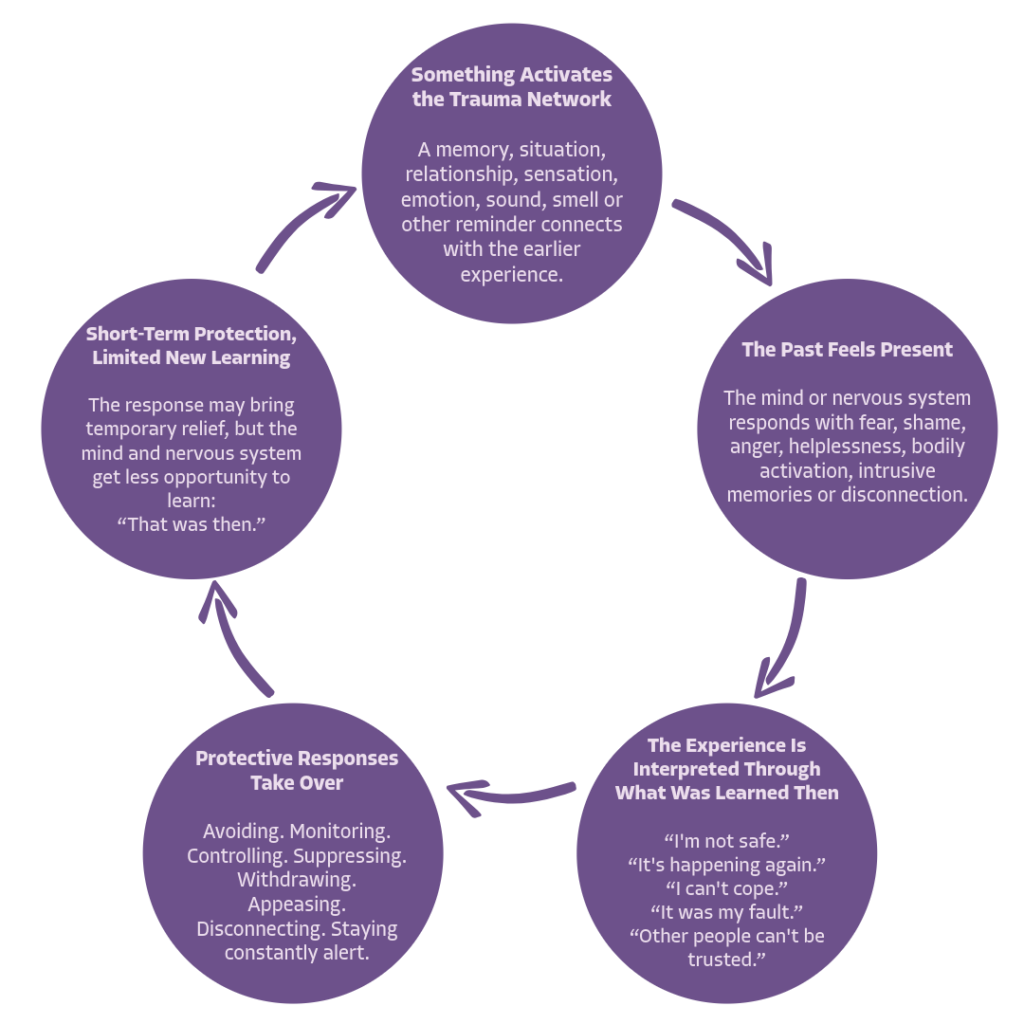
This doesn’t mean protective responses are “bad”.
Avoidance may have helped somebody function when memories felt overwhelming. Hypervigilance may once have been genuinely necessary. Appeasing may have reduced conflict. Emotional shutdown may have made something unbearable more survivable.
The question isn’t simply whether a response exists. It is whether something learned in the context of past danger is still needed in the same way now.
Shame and self-blame can also become particularly powerful maintaining processes. The memory may not only communicate “something terrible happened” but conclusions such as “I caused it,” “I should have stopped it,” “I’m weak,” or “there is something wrong with me.”
Trauma therapy isn’t about stripping away protection or convincing somebody that they should feel safe. It helps the mind and nervous system process what happened, update what has changed and develop more choice in how to respond now.
How Therapy Can Help
There is no single trauma therapy that is right for every person or every traumatic experience. Therapy begins by developing a shared understanding of what happened, how those experiences continue to affect you and what appears to be keeping aspects of the past emotionally present.
Where traumatic memories and PTSD symptoms are central to the formulation, treatment may draw on Eye Movement Desensitisation and Reprocessing (EMDR) or Trauma-Focused Cognitive Behavioural Therapy (TF-CBT), both evidence-based approaches for working with traumatic stress. That might involve processing distressing memories, working with triggers and avoidance, understanding nervous-system responses, and addressing meanings that became connected with the experience such as danger, responsibility, guilt, shame or self-blame.
Where trauma has also shaped longer-standing patterns involving relationships, trust, emotional regulation, identity or sense of self, Schema Therapy, Compassion Focused Therapy (CFT), Acceptance and Commitment Therapy (ACT) or Integrative Psychotherapy may also be useful within the wider formulation.
Therapy should also be adapted where neurodivergence, sensory processing, communication, dissociation or other individual needs influence how someone experiences or engages with the work.
Integration doesn’t mean using everything at once. The formulation guides what we use, when and why. The aim isn’t to erase the past, force forgiveness or make you unaffected by what happened. It is to help what happened become something you remember rather than something your mind and body continually have to survive.
Explore Different Types of Trauma
Trauma can take many forms, and these experiences frequently overlap. The pages below aren’t intended to decide whether something was “traumatic enough.” They offer different lenses for understanding how particular experiences may continue to affect you.
PTSD
Post-Traumatic Stress Disorder can involve intrusive memories, nightmares, avoidance, heightened threat responses and changes in how you think and feel following traumatic experiences
Complex PTSD (CPTSD)
Complex PTSD includes the core experiences of PTSD alongside longer-term difficulties involving emotional regulation, sense of self and relationships.
Childhood Trauma
Experiences during childhood can shape developing beliefs about safety, emotions, relationships and ourselves, sometimes influencing how we respond to the world much later in life.
Attachment Trauma
When relationships that should provide safety are also frightening, inconsistent, unavailable or overwhelming, this can shape how the nervous system learns about closeness, trust and vulnerability.
Relationship & Interpersonal Trauma
Traumatic experiences within intimate relationships, families or other interpersonal contexts can continue to influence safety, trust, boundaries and future relationships.
Birth Trauma
Birth can sometimes be experienced as frightening, overwhelming or involving a profound loss of safety or control, regardless of whether others describe the outcome as medically successful.
Medical Trauma
Illness, procedures, medical emergencies, intensive care, difficult diagnoses or experiences within healthcare can sometimes leave lasting trauma responses.
Grief & Traumatic Loss
Trauma and grief can become intertwined following sudden, frightening or overwhelming loss, or when the relationship with the person who died was itself complicated or traumatic.
Emotional Flashbacks
Not every flashback involves a clear image or memory. Emotional flashbacks can involve suddenly experiencing intense fear, shame, helplessness or other emotional states that feel much bigger than what is happening in the present.
Common Misconceptions About Trauma
“Trauma only happens after something catastrophic.”
Trauma can follow many different experiences. What matters isn’t simply whether an event appears severe from the outside, but how it was experienced, what resources were available at the time and what impact it continues to have.
“If other people experienced something worse, I shouldn’t be affected.”
Comparing experiences rarely tells us much about how an individual nervous system responded. Two people can experience similar events and be affected very differently.
“If I can’t remember everything clearly, it can’t have been traumatic.”
Trauma memories aren’t always experienced as clear, chronological stories. Some people remember particular moments vividly, whilst others experience fragmented memories, bodily reactions or emotional states without a complete narrative.
“Talking about trauma is the same as processing it.”
Not necessarily. Telling the story can be important, but repeatedly recounting what happened doesn’t automatically change how the memory is stored or how the nervous system responds to reminders. Trauma therapy is more than simply talking through events.
“Trauma therapy means telling you every detail.”
No. Effective trauma therapy doesn’t require disclosure of every detail simply for the sake of disclosure. We need enough information to understand your experience and work safely and effectively, but therapy remains collaborative.
“Healing means forgiving the person who hurt me.”
No. Forgiveness isn’t a requirement of trauma recovery. Therapy can help you process what happened without asking you to excuse, minimise or reconcile with somebody who harmed you.
“If I’m still affected years later, I haven’t tried hard enough to move on.”
Time alone doesn’t necessarily process traumatic experiences. People can function, build relationships and achieve enormous things whilst particular memories or nervous-system responses remain unresolved.
“Trauma responses are always fear.”
Not always. Trauma can involve fear, but also anger, shame, guilt, disgust, numbness, grief, collapse, dissociation or combinations of different emotional and bodily responses.
“Everything I struggle with now must come from trauma.”
Not necessarily. Trauma can be an important part of someone’s formulation without explaining every difficulty they experience. Good therapy remains curious rather than automatically interpreting everything through a trauma lens.
Food For Thought
What if the question wasn’t “Why am I still reacting like this?” but “What did my mind and body learn when responding this way was necessary and what do they need to learn now?”
A Note from Agi
One of the things I value most about trauma therapy is the opportunity to understand responses that people have often spent years judging themselves for. People may arrive describing themselves as too sensitive, too angry, too emotional, too detached or frustrated that they “should be over it by now”. Others know intellectually that something wasn’t their fault, yet continue carrying guilt, shame or responsibility that feels emotionally true.
When we look more closely, these responses usually have a history. Something that feels frustrating or confusing in the present may once have helped you survive, stay connected, anticipate danger or make an overwhelming experience more manageable. And conclusions such as “It was my fault,” “I should have done more,” or “there must be something wrong with me” may have developed when your mind was trying to make sense of circumstances in which you had far less choice or control than hindsight suggests.
Understanding that doesn’t mean every response needs to remain forever. Understanding isn’t resignation; it gives us a more compassionate and accurate place from which change can begin.
I also don’t believe trauma therapy should make the past the centre of someone’s identity. Processing what happened matters precisely because there is so much more to you than what happened. For me, recovery isn’t about forgetting, forgiving or becoming untouched by your history. It’s about helping the past take its place in your story, so that it becomes less able to decide how safe you feel, what you believe about yourself and what feels possible in the life you’re living now.
Frequently Asked Questions
How do I know whether what happened to me was “traumatic enough”?
You don’t need to prove that your experience meets somebody else’s threshold before bringing it to therapy. We can explore what happened and the impact it continues to have without beginning with a verdict about whether you are entitled to call it trauma.
Do I need a diagnosis of PTSD to have trauma therapy?
No. Some people meet criteria for PTSD or Complex PTSD, whilst others experience trauma-related difficulties that don’t fit neatly within a diagnosis. Therapy begins with understanding your experience rather than requiring a label first.
What’s the difference between PTSD and Complex PTSD?
Both involve core trauma symptoms such as re-experiencing, avoidance and a continued sense of threat. Complex PTSD additionally involves persistent difficulties with emotional regulation, negative self-concept and relationships.
The distinction can be useful, but your individual formulation remains more important than simply fitting yourself into the right category.
Will I have to talk about everything that happened?
No. Trauma therapy is collaborative, and you won’t be expected to disclose every detail of an experience before you’re ready or simply because somebody believes you “should.”
Different therapies also work with memories in different ways, and EMDR doesn’t require you to describe every detail aloud.
What if I remember very little about what happened?
We don’t need to recover or reconstruct a complete memory in order for therapy to be meaningful. Therapy isn’t about searching for hidden memories or filling in gaps with assumptions.
We work with what you genuinely remember and what you experience in the present.
Can trauma affect the body?
Yes. Trauma responses involve the nervous system as well as thoughts and emotions. Some people notice tension, startle responses, changes in breathing, nausea, numbness, shutdown or other physical reactions when something triggers a sense of threat.
Therapy can help us understand these responses without assuming every physical symptom is psychological.
Why do I sometimes freeze or shut down instead of feeling anxious?
Threat responses aren’t limited to fight or flight. When escape or active defence doesn’t feel possible, the nervous system may move towards freezing, shutting down, disconnecting or collapse.
These responses can feel confusing later, particularly when people judge themselves for how they reacted. Therapy can help place them back into the context in which they occurred.
What if the person who traumatised me was also someone I loved?
Relationships can contain love, attachment, fear, hurt, loyalty and grief at the same time. Trauma therapy doesn’t require you to simplify that relationship into entirely good or entirely bad.
We can make space for complexity without minimising what happened.
Can grief and trauma happen together?
Yes. A death can involve both grief and traumatic stress, particularly when the circumstances were sudden, frightening or overwhelming. Trauma may also coexist with grief when the relationship itself was complicated or harmful.
Grief isn’t limited to sadness. Love, anger, longing, guilt, numbness, relief and even moments of happiness can coexist, depending on the relationship and what you experienced.
Is EMDR only for PTSD?
No. EMDR has its strongest established evidence base in PTSD, but EMDR-informed work may also be considered within broader formulations where distressing experiences or memories continue to influence present difficulties.
Whether EMDR is appropriate depends on what we’re trying to address and why not simply whether a particular diagnosis is present.
What if I don’t feel ready to process memories?
We don’t begin trauma processing simply because trauma exists in your history. Assessment helps us understand what you’re experiencing, your current circumstances and what approach makes sense.
Sometimes the work initially focuses on understanding patterns, strengthening resources, relationships or emotional regulation. The pace and sequencing should have a clinical rationale rather than following a predetermined timetable.
Can trauma therapy help with shame and self-blame?
Yes. Trauma can leave people carrying powerful meanings about themselves, including responsibility, defectiveness, weakness or shame. These meanings may become important targets within TF-CBT, EMDR, Schema Therapy, CFT or other formulation-led work.
What if I’m neurodivergent?
Neurodivergence can influence sensory processing, communication, emotional regulation, interoception and how experiences are processed or remembered. It may also shape which environments feel safe or overwhelming.
Therapy can be adapted around your individual communication, sensory and processing needs rather than expecting you to engage in a particular neurotypical way.
Can therapy be delivered online?
Yes. Many psychological therapies can be delivered effectively online, depending on the individual and the type of therapy being offered.
I provide online therapy across the UK, as well as working internationally where appropriate and where professional and regulatory requirements allow. For people who prefer face-to-face therapy, I offer in-person appointments in Menai Bridge, Anglesey and Llandudno, Conwy, North Wales.
During the initial assessment, we can consider whether online or in-person therapy is the best fit and discuss any practical or clinical factors that may influence how therapy is delivered.
How Do We Start?
If experiences from the past continue to affect how you feel, relate to other people or live in the present, you’re welcome to book a free 15-minute discovery call.
You don’t need to arrive knowing whether your experience is best described as PTSD, Complex PTSD, attachment trauma or something else. We’ll begin by understanding what happened, what you’re experiencing now and what appears to be keeping the past emotionally present.
Together, we’ll develop a formulation that considers the whole picture, not only traumatic memories, but also emotions, relationships, beliefs, nervous-system responses, neurodivergence, identity and the ways you’ve learned to protect yourself.
Trauma therapy isn’t about forgetting what happened or becoming unaffected by your history. It’s about helping the past take its place in your story without continuing to dictate the present.
If You Only Take One Thing Away…
Trauma can shape how your mind and body learned to survive, but those responses don’t have to remain organised around the past forever. Therapy can help your nervous system recognise what has changed and create more freedom in how you live now.