
Specialist evidence-based therapy for OCD, helping you understand obsessional doubt, reduce compulsions and create greater freedom in how you respond to uncertainty.
Obsessive-Compulsive Disorder (OCD) is often misunderstood. It’s far more than liking things organised, double-checking the door or being “a bit particular.” OCD can involve intrusive thoughts, images, sensations, urges, memories or doubts that become difficult to leave alone, alongside attempts to understand, prevent, neutralise or gain certainty about them.
OCD can become attached to almost anything that feels important: relationships, health, morality, sexuality, memories, religion, contamination, responsibility, identity, harm, or simply the need for something to feel “just right.” Compulsions may be visible, such as washing, checking or repeating, but they can also happen entirely internally through analysing, reviewing, monitoring, testing or trying to work something out.
At Food For Thought Therapy, I don’t see these responses as meaningless or irrational. Compulsions usually make sense within the OCD story. When a doubt feels important, threatening or unresolved, doing something to settle it can feel like the responsible or sensible response. The difficulty is that the answer rarely stays answered.
Therapy begins by understanding how OCD is operating for you. Together, we’ll develop a shared formulation of what creates the doubt, what gives it credibility and what keeps the cycle going before identifying the evidence-based approaches most likely to help.
Understanding OCD
Unwanted, unexpected or uncomfortable thoughts and sensations are part of ordinary human experience. With OCD, however, a particular experience can begin to feel significant enough that it requires a response. Your mind may begin asking:

The content can vary enormously, and OCD themes can change over time. What often remains more consistent is the pressure to do something with the doubt: analyse it, check it, disprove it, prevent a feared possibility or reach a particular feeling of certainty.
Resolving one question doesn’t necessarily end the process. Another detail may become important, a new possibility appears or something that felt settled yesterday suddenly feels uncertain again.
OCD can therefore become less about the original thought and increasingly about everything you feel you need to do because the thought appeared..
How OCD Can Affect Everyday Life
OCD can affect almost every area of life, and much of it may be invisible to other people. Someone can appear to be carrying on as usual whilst internally spending significant time checking, analysing, reviewing or trying to resolve doubt. You might notice:
- Checking, repeatedly returning to something you’ve already checked.
- Seeking reassurance, asking loved ones, professionals or online communities for answers.
- Mental reviewing, replaying conversations, memories, journeys or decisions.
- Researching, searching for information to settle a particular doubt.
- Monitoring yourself, checking thoughts, emotions, intentions, attraction or bodily sensations.
- Avoiding, staying away from people, places, objects or situations that trigger doubt.
- Repeating or correcting, doing something again until it feels complete or “right.”
- Testing, deliberately checking how you think, feel or react to determine what it means.
- Delaying decisions, feeling unable to choose or move forward without greater certainty.
- Organising life around OCD, changing routines, relationships or opportunities to prevent triggers or uncertainty.
OCD doesn’t have to look dramatic from the outside to take up an enormous amount of space internally. For some people, the most exhausting compulsions are the ones nobody else can see.
What Keeps OCD Going?
OCD isn’t maintained simply because intrusive thoughts, sensations or doubts appear. The cycle can become maintained through the understandable things we do in response to them.
Checking may briefly settle a doubt. Reassurance can provide relief. Research may seem to offer clarity. Mental reviewing can feel responsible. Avoidance may feel safer. Repeating an action might temporarily create the sense that something is finally complete.
Each response makes sense within the OCD story. Importantly, the same behaviour can serve very different purposes for different people. Two people might both wash, check or repeat something, but the doubt, fear or feeling driving that behaviour may be completely different. This is why effective OCD therapy looks beyond what you do to understand what the compulsion is trying to resolve, prevent or establish.
The difficulty is that relief doesn’t necessarily last. Another question appears, certainty fades, a different interpretation becomes possible or the feeling of “done” disappears. What worked briefly can therefore become something you feel increasingly compelled to repeat.
Over time, OCD can make checking feel responsible, analysing feel necessary and uncertainty feel like something that shouldn’t be left alone.
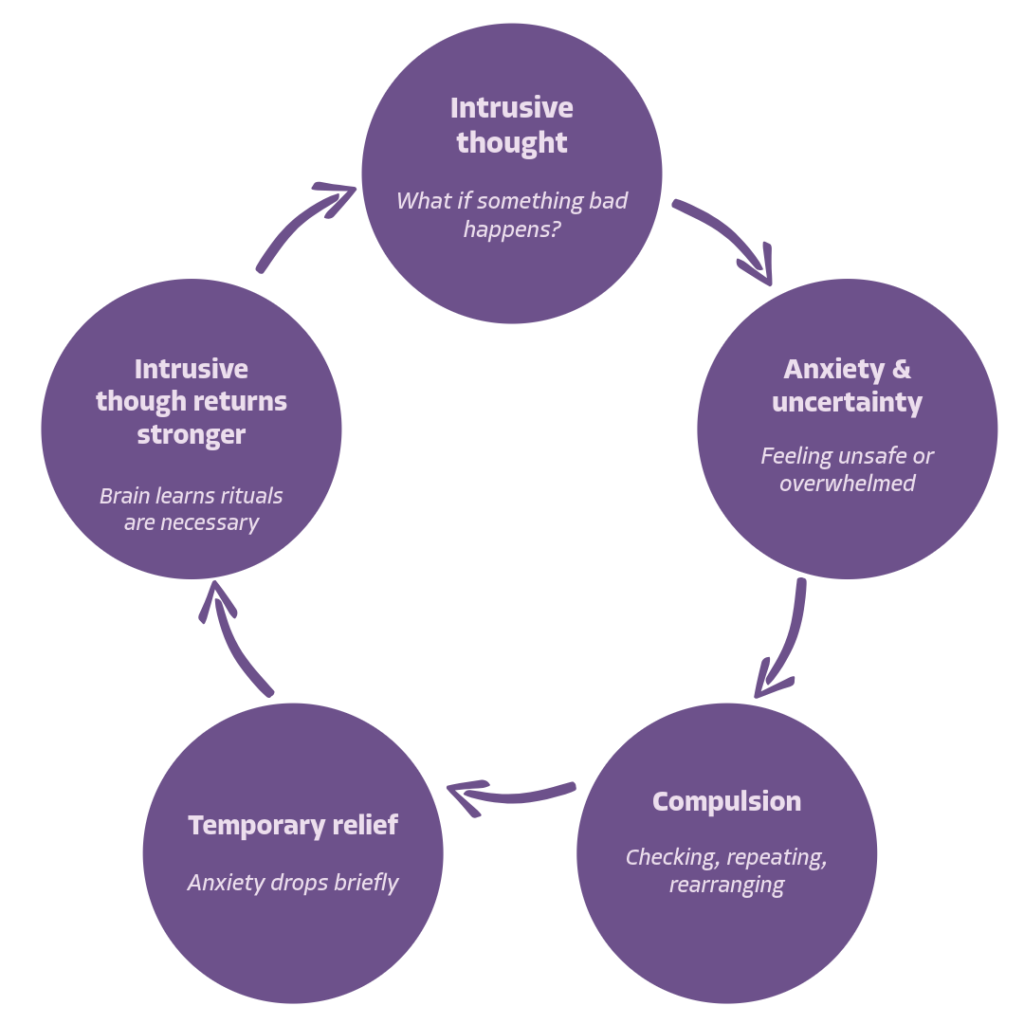
Effective therapy helps us understand this cycle and develop different ways of responding, rather than trying to eliminate every intrusive experience or answer every question OCD creates.
How Therapy Can Help
There is no single therapy that is right for every person with OCD. We begin by understanding how OCD is operating in your life, what keeps the cycle going and what you would like to become more able to do.
Depending on your formulation, therapy may draw from Cognitive Behavioural Therapy (CBT), Exposure and Response Prevention (ERP), Inference-Based Cognitive Behavioural Therapy (I-CBT) and Acceptance and Commitment Therapy (ACT) to work with obsessional doubt, compulsions, avoidance and uncertainty.
Where OCD is intertwined with longer-standing patterns or previous experiences, I may also thoughtfully integrate Schema Therapy or EMDR, whilst remaining careful not to turn therapy into another way of analysing or seeking certainty about obsessional fears.
Integration doesn’t mean using everything at once. Your formulation guides what we use, when and why. The aim isn’t to prove your fears impossible or provide certainty, but to create greater freedom in how you respond when OCD creates doubt.
Explore Different Types of OCD
Although OCD themes can look very different on the surface, similar processes of doubt, uncertainty and compulsive responding can appear across them.
The categories below aren’t rigid diagnoses or separate types of OCD. They’re simply useful ways of exploring some of the themes OCD can become organised around.
Contamination OCD
Fears involving contamination, illness, substances, bodily fluids or feelings of being physically or morally “unclean.”
Harm OCD
Intrusive doubts, thoughts, images or urges involving the possibility of causing harm to yourself or somebody else.
Relationship OCD (ROCD)
Persistent doubts and uncertainty involving relationships, feelings, attraction, compatibility or whether a relationship is “right.”
False Memory OCD
Becoming caught in uncertainty about whether something may have happened, often accompanied by repeated memory reviewing and attempts to reconstruct events.
Real Event OCD
Becoming consumed by something that genuinely happened and repeatedly analysing what it means about you, your responsibility or what should happen next.
Moral & Scrupulosity OCD
Doubts centred around morality, religion, values, responsibility or fears of being a “bad” person.
Health OCD
Persistent doubts about illness or health that become caught in checking, researching, monitoring or reassurance-seeking.
Sexual Orientation OCD
Obsessive doubt involving sexual orientation, attraction and what thoughts, sensations or reactions might mean.
Sensorimotor OCD
Heightened attention to normally automatic bodily sensations or processes, such as breathing, swallowing, blinking or other physical experiences.
Hit and Run OCD
Persistent doubts about whether you may have caused an accident or harmed somebody whilst driving.
Just Right OCD
A powerful sense of incompleteness or that something needs to be repeated, adjusted or performed until it feels “right.”
Existential OCD
Repeated attempts to resolve questions about existence, reality, consciousness, meaning or other questions that cannot easily provide complete certainty.
Pedophilia OCD (POCD)
Distressing obsessional doubts involving attraction, identity and the possibility of sexual harm towards children.
Common Misconceptions About OCD
“OCD is mainly about cleanliness and organisation.”
Contamination and cleaning are only some presentations of OCD. OCD can become organised around almost anything, including relationships, harm, morality, sexuality, religion, health, memories, identity, bodily sensations or feelings of incompleteness. Many compulsions are also entirely mental.
“If I know my fear is unlikely, I should be able to stop worrying.”
OCD isn’t simply a lack of logical understanding. You may recognise that something seems unlikely whilst still experiencing a powerful need to check, analyse or resolve it. Repeatedly constructing better arguments against the fear can itself become part of the cycle.
“Intrusive thoughts are the problem.”
Intrusive experiences are common. In OCD, what often becomes particularly important is what happens next: why an experience becomes significant, how doubt develops and what you then do to resolve, neutralise or gain certainty about it.
“Compulsions are always obvious.”
Many compulsions happen internally. Analysing feelings, reviewing memories, comparing reactions, mentally checking, monitoring sensations and repeatedly trying to “figure something out” can consume hours without anybody else noticing.
“If a compulsion makes me feel better, it must be helping.”
Compulsions often do provide short-term relief, that’s part of why they become so compelling. The difficulty is that relief may strengthen the perceived need to respond again when the next doubt appears.
“Recovery means becoming certain that my fear won’t happen.”
Trying to achieve complete certainty can itself become part of OCD. Therapy isn’t about replacing frightening uncertainty with reassuring certainty; it’s about helping you respond differently when your mind demands an answer.
“ERP means being forced to confront my worst fears.”
Good ERP is collaborative and based on a clear therapeutic rationale. It isn’t about frightening somebody for the sake of it or forcing them into situations without preparation. Exposure is used thoughtfully to create new learning whilst reducing compulsive responding.
“ERP is the only treatment for OCD.”
ERP has a strong evidence base, but it isn’t the only psychological approach. Depending on the formulation, treatment may also include I-CBT, ACT and other cognitive or formulation-led interventions.
“If my OCD changes theme, I’ve developed a completely different problem.”
OCD themes can change. Focusing only on content can therefore become like repeatedly playing whack-a-mole. Therapy aims to help you recognise and change the processes underneath the theme.
Food For Thought
OCD convinces us that every doubt deserves an answer. What might become possible if you didn’t have to finish every question your mind started?
A Note from Agi
One of the things I hear most often from people with OCD is, “I know it probably doesn’t make sense, but it feels so real.” For me, that captures something important about why OCD can be so difficult to simply “think your way out of.”
I’m less interested in telling someone that their fear is irrational and much more interested in understanding why this particular doubt has become so convincing. What happened before the checking? Why did this possibility become important? What is analysing, researching or seeking reassurance trying to achieve?
I also don’t believe OCD treatment needs to become a battle between you and your thoughts. Different people become stuck at different points in the cycle, which is why therapy should be guided by an individual formulation rather than simply applying the same technique to everyone.
For me, recovery isn’t about reaching a state where uncertainty disappears. It’s about helping OCD take up less space so that your relationships, values, interests and life can become louder again.
Frequently Asked Questions
Does everyone experience intrusive thoughts?
Unwanted thoughts, images and impulses are common human experiences and can involve strange, upsetting or uncomfortable content. In OCD, the difficulty often begins when a particular experience feels significant enough that it needs to be understood, disproved, prevented or resolved.
Therapy doesn’t involve repeatedly establishing what an individual thought “really means.” Instead, we’re interested in why this particular thought has become something your mind feels unable to leave unanswered and what happens when you try to resolve it.
How do I know if it’s OCD or a genuine concern?
This is an understandable question, but trying to establish complete certainty about whether something is “really OCD” can sometimes become another part of the cycle.
Rather than repeatedly deciding whether each individual concern is legitimate, therapy looks at the wider process. Are you repeatedly checking, analysing, researching, reviewing, testing or seeking reassurance? What happens when you obtain an answer? Does the question stay resolved, or does another doubt quickly appear?
The process surrounding the concern can often tell us more than repeatedly analysing its content.
Why does OCD still feel convincing when I can see the logic doesn’t add up?
Intellectual understanding and felt certainty aren’t necessarily the same thing. You may recognise one perspective logically whilst still experiencing a powerful sense that something needs checking or resolving.
Rather than repeatedly trying to make the fear feel less convincing through reassurance, therapy helps us understand what gives the doubt its credibility and what keeps drawing you back into responding to it.
Can OCD make me question my identity?
Identity, sexuality, morality, relationships and values can all become areas around which obsessional doubt develops. The difficulty can then shift from exploring yourself with curiosity to repeatedly checking thoughts, feelings, memories or reactions in an attempt to establish certainty about what they mean.
Therapy doesn’t provide a definitive answer to those questions. Instead, it helps us recognise when the search for certainty itself has become the problem and make space for uncertainty without repeatedly analysing it.
Can OCD change themes?
Yes. The content of OCD can shift considerably over time. This is one reason therapy focuses not only on the current theme but on the underlying processes of obsessional doubt and compulsive responding.
Why does reassurance only help temporarily?
Reassurance may genuinely reduce distress in the moment. When it becomes something you repeatedly need in order to settle obsessional doubt, however, the relief may become increasingly short-lived. Another exception, possibility or question appears, restarting the search for certainty.
Do I need ERP?
ERP is an important evidence-based treatment for OCD, but treatment should be guided by your individual formulation. Depending on how your OCD operates, therapy may also draw from I-CBT, ACT and cognitive approaches, or combine elements of different evidence-based treatments.
What if I’ve had OCD therapy before and it didn’t help?
There can be many reasons why previous therapy didn’t produce the change you hoped for. Mental compulsions may have been difficult to recognise, treatment may have focused primarily on the content rather than the processes maintaining the difficulty, or the particular approach may not have been the right fit for you.
Assessment can help us understand what was previously tried, what was helpful or unhelpful and whether approaching the difficulty differently may be appropriate.
Will I have to tell you every intrusive thought?
No. Understanding OCD doesn’t require you to provide an exhaustive account of every thought you’ve ever experienced. We need enough information to develop a meaningful formulation, but therapy can proceed collaboratively and at a pace that allows us to understand the relevant patterns without turning disclosure itself into another test you have to pass.
What if I don’t know which type of OCD I have?
That’s completely okay. The subtype labels on these pages are useful ways of describing common themes rather than separate diagnoses you need to identify correctly.
Many people recognise themselves across several themes, and OCD can change its focus over time. Therapy is much more interested in understanding how your OCD works than finding the perfect category for it.
Can OCD be treated online?
Yes. Evidence-based psychological treatment for OCD can be delivered online, and for some people working within their everyday environment can also be useful therapeutically. I offer online therapy throughout the UK alongside in-person appointments in Menai Bridge and Llandudno.
What if I’m not sure I’m “ill enough” for therapy?
You don’t need to establish whether your OCD is severe enough before you’re allowed to ask for help, and repeatedly trying to determine whether you “really qualify” can sometimes become another question that never feels completely settled.
A more useful starting point is considering the impact. If doubt, compulsions, avoidance or mental rituals are taking up significant time or energy, affecting relationships or restricting how you want to live, we can explore what is happening together.
How Do We Start?
If OCD is taking up more of your time, energy or the life you want to live, you’re welcome to book a free 15-minute discovery call.
We’ll begin by understanding how OCD operates for you: what tends to create doubt, what makes particular possibilities feel convincing and what you find yourself doing to resolve, prevent or gain certainty about them. We’ll also look at the wider picture, including mental compulsions, avoidance and the impact OCD is having on your everyday life.
From there, we’ll develop a shared formulation and discuss which evidence-based approach, or combination of approaches, may be most helpful. You don’t need to know which OCD subtype you have, decide whether you need ERP or I-CBT, or arrive having worked out exactly what is happening.
Therapy won’t be about proving your fears impossible or providing certainty whenever OCD asks another question. It will be about helping you understand the process, step away from the patterns that keep pulling you back into doubt and gradually make more room for the life you want to live.
You don’t have to answer every doubt before you can move forward.
If You Only Take One Thing Away…
OCD may change its theme, but the pattern often remains familiar: doubt becomes important, certainty starts to feel necessary and life gradually becomes organised around trying to resolve it. Recovery begins when every doubt no longer needs an answer before you can move forward.