
Evidence-based therapy to help you understand the patterns shaping how you relate to yourself, your emotions and the people around you, and create greater freedom in how you respond.
The way we experience ourselves and relationships develops over time. Our experiences, relationships, culture, identity, neurodivergence, temperament and the environments we move through can all influence what we learn about ourselves, other people and what it takes to feel accepted, safe or connected.
Sometimes these patterns work well for us. At other times, we may notice ourselves repeatedly putting other people’s needs before our own, struggling to set boundaries, feeling deeply affected by rejection, pushing ourselves relentlessly or finding closeness difficult even when relationships matter enormously to us.
For some people, these difficulties are visible. For others, much of the work happens internally: questioning whether you’ve upset someone, analysing how you came across, hiding emotions, criticising yourself, trying to meet impossible standards or changing yourself depending on who you’re with.
These experiences don’t automatically mean there is something wrong with your personality, and therapy isn’t about teaching you the “correct” way to relate to yourself or other people.
It is about understanding how your patterns developed, what they are doing for you now and whether they leave enough space for your needs, values, relationships and the person you want to be.
Understanding Self & Relationships
How we relate to ourselves often influences how we relate to other people, and vice versa. If you’ve learned that acceptance depends on being helpful, successful or easy to be around, saying no may feel surprisingly difficult. If relationships have felt unpredictable, you may become particularly alert to changes in someone’s tone or behaviour. If mistakes have been met with criticism, you might learn to criticise yourself first. The mind may begin asking:

These patterns can develop for many different reasons. Relationships and earlier experiences can influence what we learn about closeness, trust, responsibility and our own needs. Culture, family and community can shape expectations around independence, achievement, boundaries and belonging.
Neurodivergence can also influence emotional intensity, sensory experiences, communication, rejection sensitivity and the effort involved in navigating social expectations. Experiences of marginalisation or repeatedly feeling misunderstood can affect how safe it feels to express particular parts of ourselves.
Importantly, the same behaviour can mean very different things for different people. Someone who rarely asks for help may genuinely value independence, whilst somebody else may have learned that depending on people leads to disappointment. Caring for others may be deeply meaningful, or it may feel like the only way to remain accepted. And sometimes the difficulty isn’t primarily inside the individual at all. Relationships, expectations and environments can genuinely ask too much of us.
Understanding the context helps us distinguish between something we might want to change, something that needs support or accommodation, and something that may not be a problem at all.
How Difficulties With Self & Relationships Can Affect Everyday Life
Patterns involving self-worth, emotions and relationships can influence far more than our closest relationships. They can shape how we work, parent, socialise, make decisions, respond to feedback, rest and decide what we’re allowed to need.
You might notice:
- Self-criticism, feeling that you’re never quite good enough or holding yourself to standards you wouldn’t expect from somebody else.
- People-pleasing, saying yes when you want to say no or feeling responsible for keeping other people happy.
- Difficulty expressing needs, finding it easier to understand what other people need than recognising or communicating your own.
- Boundary difficulties, struggling to set limits or needing very firm boundaries in order to feel safe.
- Rejection sensitivity, feeling particularly affected by criticism, disapproval, exclusion or changes in how somebody responds to you.
- Relationship monitoring, analysing conversations, changes in tone or other people’s behaviour for signs that something may be wrong.
- Difficulty with closeness, wanting connection whilst finding trust, dependence or vulnerability uncomfortable.
- Emotional overwhelm or disconnection, experiencing emotions very intensely or finding yourself shutting down and struggling to access them.
- Uncertainty about identity, feeling unsure who you are outside particular roles, relationships or other people’s expectations.
- Perfectionism and overachievement, pushing yourself relentlessly or feeling that your worth depends on what you achieve.
- Masking and adapting, changing how you communicate, behave or express yourself in order to fit expectations or belong.
These patterns can be particularly difficult because they often coexist with genuine strengths. Someone can be caring and people-please, ambitious and perfectionistic, independent and frightened of relying on others.
For neurodivergent people, years of masking or navigating environments designed around different needs can also influence identity and self-worth. What appears to be low confidence may sometimes reflect repeated experiences of being misunderstood, criticised or expected to function in ways that require enormous effort.
Over time, life can become increasingly organised around being acceptable, avoiding rejection, meeting expectations, staying in control or protecting yourself, rather than around your own needs, values and what genuinely matters to you.
What Keeps These Difficulties Going?
Patterns often continue because, somewhere along the way, they made sense.
People-pleasing may reduce conflict or protect relationships. Perfectionism may help you feel competent or less vulnerable to criticism. Self-criticism may feel like a way to prevent mistakes. Emotional shutdown may protect against overwhelm. Hyper-independence may reduce the risk of disappointment, whilst constantly monitoring relationships may feel like a way of preventing rejection.
The difficulty is that strategies that provide short-term protection can sometimes create longer-term costs.
Never expressing your needs can create resentment or exhaustion. Avoiding vulnerability may reduce immediate discomfort whilst making closeness harder. Constantly analysing other people’s reactions may increase rather than resolve uncertainty. Pushing yourself relentlessly may eventually contribute to burnout.
Therapy helps us understand what a pattern protects you from, what it costs you and whether there are other ways of meeting the same underlying need.
What Keeps These Patterns Going?
Patterns often continue because, somewhere along the way, they made sense. People-pleasing may reduce conflict. Perfectionism may reduce vulnerability to criticism. Self-criticism can feel like a way to prevent mistakes. Emotional shutdown may protect against overwhelm. Hyper-independence may reduce the possibility of disappointment.
The difficulty is that strategies providing short-term protection can sometimes create longer-term costs. This can create a reinforcing cycle:
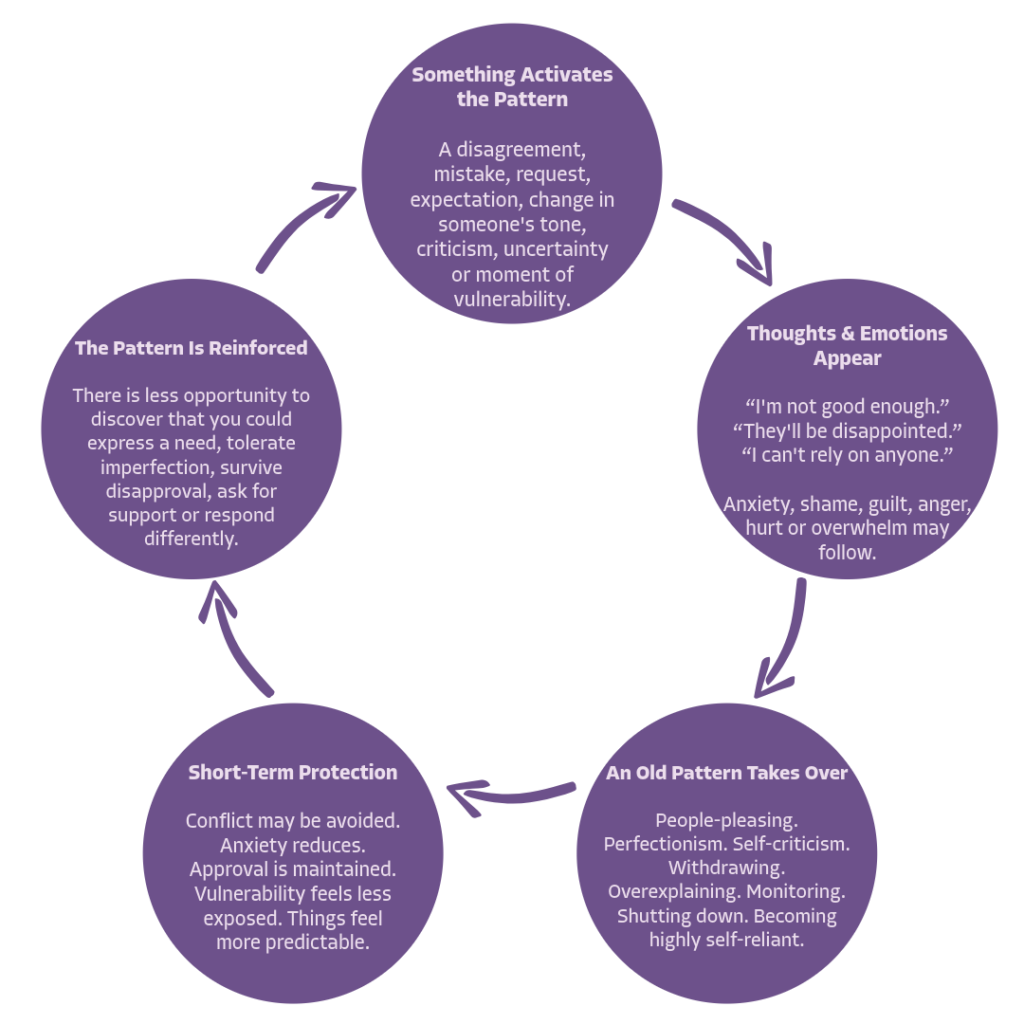
This doesn’t mean the pattern is inherently unhealthy. Being independent, ambitious, caring, sensitive or accommodating can all be strengths. The more useful question is whether you have enough choice.
Can you say yes because you want to rather than because saying no feels impossible? Can you strive towards something without your worth depending on the outcome? Can you protect yourself when necessary whilst still allowing closeness when it feels safe?
Therapy isn’t about replacing one rigid way of being with another. It’s about creating more flexibility in how you respond.
How Therapy Can Help
There is no single therapy for difficulties involving self-worth, emotions and relationships because there is no single pattern or explanation. Therapy begins by developing a shared understanding of what you’re noticing, how those patterns developed, what appears to activate them and what they may be helping you manage or protect yourself from.
Depending on your formulation, Schema Therapy can be particularly helpful for understanding long-standing beliefs, emotional needs and recurring patterns in how you relate to yourself and other people. Compassion Focused Therapy (CFT) may support work with shame and harsh self-criticism, whilst Cognitive Behavioural Therapy (CBT) can help us understand and change specific cycles that continue to create difficulties.
Acceptance and Commitment Therapy (ACT) may be useful where the work involves values, identity, emotional flexibility or creating space for difficult internal experiences. EMDR may be considered where particular distressing experiences continue to shape present beliefs or responses, whilst Integrative Psychotherapy can provide space to understand the wider relational and emotional story.
Where neurodivergence is relevant, therapy should also consider communication, sensory experiences, masking, executive functioning and the environments someone is trying to navigate rather than automatically treating difference as something that needs changing.
Integration doesn’t mean using everything at once. The formulation guides what we use, when and why. The aim isn’t to create a different personality. It is to develop greater understanding, flexibility and choice in how you relate to yourself and the people around you.
Explore Self & Relationships
These areas often overlap. You may recognise yourself across several pages, or find that one becomes more relevant at different points in your life. They aren’t labels you need to fit within, but different lenses through which we can understand your experience.
Low Self-Esteem
When beliefs about not being good enough, capable enough or worthy enough begin shaping how you treat yourself and the choices you make.
Perfectionism
When striving, high standards or avoiding mistakes become increasingly tied to self-worth, anxiety or the feeling that what you do is never quite enough.
People-Pleasing, Assertiveness & Boundaries
Exploring the balance between caring for others and making space for yourself, including when saying yes, saying no, accommodating others or protecting your boundaries becomes difficult.
Attachment Difficulties
Understanding recurring patterns around closeness, trust, dependence, vulnerability and connection without reducing relationships to a single “attachment style.”
Relationship Difficulties
Exploring patterns involving communication, conflict, closeness, trust, needs and recurring difficulties within relationships without assuming one person is always the problem.
Rejection Sensitivity
When actual or perceived rejection, criticism or exclusion creates a particularly powerful emotional response, including experiences that may be relevant for ADHD and other neurodivergent people.
Emotional Regulation
Understanding emotions that feel “too big,” overwhelming or difficult to recover from, as well as experiences of shutting down, disconnecting or feeling that you don’t show enough emotion.
Shame & Self-Criticism
When mistakes, vulnerability or difficult experiences become connected with a deeper sense that something is wrong with you, often accompanied by harsh internal criticism, withdrawal, freezing or collapse.
Burnout
Understanding prolonged depletion and reduced capacity, including stress-related burnout and experiences of autistic burnout associated with masking, sensory demands and repeatedly exceeding sustainable capacity.
Impostor Syndrome
When achievements struggle to feel genuinely yours and success becomes accompanied by fears of being exposed, undeserving or somehow not as capable as other people believe.
Identity & Sense of Self
Exploring who you are beyond expectations, roles and other people’s perceptions, whilst recognising the influence of culture, sexuality, gender, neurodivergence, relationships and lived experience.
Common Misconceptions About Self & Relationships
“If I struggle with relationships, I must have an attachment problem.”
Not necessarily. Relationship difficulties can develop for many reasons, including communication differences, incompatible needs, current stress, previous experiences, neurodivergence or simply being in a relationship that isn’t working well. Attachment can be one useful lens, but it isn’t the answer to everything.
“Good boundaries mean saying no more often.”
Not always. Boundaries are about recognising what is and isn’t okay for you and communicating this where appropriate. Sometimes that means saying no; sometimes it means choosing to say yes. Assertiveness is about greater choice rather than automatically becoming firmer.
“People pleasing means I’m weak.”
Caring about other people’s feelings, cooperating and adapting are not weaknesses. The difficulty arises when accommodating others repeatedly comes at the expense of your own needs or feels like the only safe way to maintain relationships.
“If I’m sensitive to rejection, I’m overreacting.”
Emotional intensity needs context. Previous experiences, neurodivergence, current relationships and the significance of belonging can all influence how rejection is experienced. Therapy isn’t about telling you that you shouldn’t feel something; it’s about understanding the response and increasing flexibility around what happens next.
“Being emotional means I’m dysregulated.”
No. Strong emotions aren’t automatically evidence of poor emotional regulation. Regulation is more about how we recognise, tolerate and respond to emotions than how intensely we experience them.
Equally, appearing calm doesn’t necessarily mean somebody is regulated. Shutdown, suppression or disconnection can look very composed from the outside.
“My emotions tell me what is true.”
Emotions provide important information about our experience, but they aren’t always factual conclusions about what is happening. Feeling rejected doesn’t necessarily establish that rejection has occurred; feeling guilty doesn’t automatically establish responsibility.
This distinction is particularly important when emotional reasoning becomes part of anxiety or OCD. Therapy helps us listen to emotions without requiring them to act as evidence.
“Perfectionism is just having high standards.”
High standards can be meaningful and motivating. Perfectionism becomes more difficult when self-worth, safety or permission to rest increasingly depend on meeting those standards, or when “good enough” stops feeling available.
“Self-criticism keeps me motivated.”
It can sometimes create short-term action, but fear and criticism aren’t the only ways to motivate ourselves. For many people, relentless self-criticism eventually contributes to shame, avoidance, procrastination or exhaustion.
“Burnout means I need to become more resilient.”
Sometimes skills and coping strategies help. Sometimes the demands themselves are unsustainable. Therapy shouldn’t simply help someone tolerate an environment that continually exceeds their capacity.
“Finding my identity means discovering one definitive answer about who I really am.”
Identity can develop, shift and contain complexity. Exploration doesn’t always need to end in certainty. This is particularly important where questions about identity have become caught within an OCD cycle, because repeatedly analysing thoughts, feelings or reactions for a definitive answer may strengthen rather than resolve obsessional doubt.
Food For Thought
Instead of asking “What’s wrong with the way I am?”, what might change if you became curious about what your patterns have been trying to help you navigate?
A Note from Agi
One of the things I value most about this work is resisting the temptation to turn every human difference into something that needs fixing.
Being sensitive isn’t inherently a problem. Neither is being independent, ambitious, emotional, quiet, accommodating or needing more space than somebody else. Neurodivergent people in particular may have spent years receiving messages that their natural ways of communicating, regulating or relating are somehow “too much” or “not enough.”
FFor me, the more useful question is often whether you have enough choice. Can you say yes because you want to rather than because saying no feels impossible? Can you strive towards something that matters without your worth depending on the outcome? Can you experience a powerful emotion without immediately treating it as evidence? Can you be close to somebody whilst remaining connected to yourself?
Sometimes therapy involves changing a pattern. Sometimes it involves understanding that you weren’t the problem in the first place. And sometimes it involves recognising that a response which once made complete sense simply doesn’t need to work quite so hard anymore.
Therapy isn’t about creating a better personality. It’s about understanding yourself well enough that old patterns no longer have to make every decision for you.
Frequently Asked Questions
Do I need a diagnosis to work on these difficulties?
No. Many of the experiences within this hub aren’t disorders in themselves. You might simply recognise a pattern in your relationships, self-esteem or emotional life that you would like to understand or change.
How do I know whether something is my pattern or whether another person is genuinely treating me badly?
Therapy shouldn’t automatically locate every relationship difficulty inside you. Sometimes there is a personal pattern worth exploring; sometimes another person’s behaviour genuinely isn’t okay; often both personal history and current circumstances matter.
We can explore what is happening without assuming in advance where responsibility lies.
Can attachment styles change?
Attachment isn’t a fixed personality type. How we relate can vary across relationships, circumstances and stages of life, and new relational experiences can influence established patterns.
I prefer using attachment as one lens for understanding relationships rather than placing people permanently into categories such as “anxious” or “avoidant.”
Does setting boundaries mean putting myself first?
Not necessarily. Healthy relationships often involve compromise, generosity and considering other people’s needs. Boundaries aren’t about always prioritising yourself; they’re about being able to include your needs as part of the relationship too.
Can I be assertive and still be a people pleaser?
Yes. Patterns aren’t always consistent. Someone may be highly assertive at work but find saying no almost impossible within family relationships. Others may appear very direct when overwhelmed whilst accommodating people extensively in other situations.
Therapy helps us understand the context rather than deciding which label fits.
Are intense emotions unhealthy?
Not inherently. Some people simply experience emotions intensely, and neurodivergence, temperament and sensory processing can all influence this.
The question is less “How big is the emotion?” and more what happens around it, how difficult it is to recover and whether your responses are helping you live the way you want to.
Can I trust my emotions?
Emotions are meaningful signals about your internal experience, but a signal and a fact aren’t the same thing.
Feeling unsafe, rejected, guilty or inadequate deserves curiosity. It doesn’t necessarily prove that danger, rejection, responsibility or inadequacy is objectively present. Therapy can help develop space between what I feel and what I conclude because I feel it.
How does neurodivergence fit into this work?
Neurodivergence can influence emotional intensity, sensory processing, executive functioning, rejection sensitivity, communication, identity, relationships and the effort involved in navigating environments designed around different needs.
Therapy shouldn’t automatically interpret neurodivergent differences as psychological problems. We distinguish what genuinely needs support from what may need understanding, accommodation or a different environment.
What if I don’t know who I am?
You don’t need to arrive with a clear answer. Identity can be explored with curiosity rather than treated as a puzzle that has one correct solution.
Where identity questions have become repetitive, urgent and driven by a need for complete certainty, we’ll also consider whether anxiety or OCD processes may be involved rather than unintentionally turning therapy into another place to repeatedly check.
Is people pleasing always caused by trauma?
No. People pleasing can develop through temperament, family roles, cultural expectations, relationships, social learning, neurodivergent masking and many other experiences. Trauma may be relevant for some people, but it shouldn’t automatically be assumed.
Is burnout the same as depression?
They can overlap, but they aren’t necessarily the same experience. Burnout may involve profound depletion following prolonged demands, whilst depression involves its own broader pattern of emotional, cognitive and behavioural changes.
Understanding the context and overall picture helps us distinguish what may be happening rather than relying on one symptom.
Can therapy change long-standing patterns?
Patterns that have existed for many years can feel deeply ingrained, particularly when they once served an important function. Change doesn’t require erasing your history or becoming a completely different person.
Therapy can help you notice patterns earlier, understand what activates them and gradually develop more options for responding.
Can EMDR help with self-esteem or relationship difficulties?
Sometimes, where particular distressing experiences continue to shape beliefs about yourself or responses within relationships. EMDR isn’t automatically appropriate simply because something difficult happened, so its use would depend on your individual formulation.
Can therapy be delivered online?
Yes. Many psychological therapies can be delivered effectively online, depending on the individual and the type of therapy being offered.
I provide online therapy across the UK, as well as working internationally where appropriate and where professional and regulatory requirements allow. For people who prefer face-to-face therapy, I offer in-person appointments in Menai Bridge, Anglesey and Llandudno, Conwy, North Wales.
During the initial assessment, we can consider whether online or in-person therapy is the best fit and discuss any practical or clinical factors that may influence how therapy is delivered.
How Do We Start?
If patterns involving your self-worth, emotions or relationships are taking up more space in your life than you would like, you’re welcome to book a free 15-minute discovery call.
You don’t need to arrive knowing whether the difficulty is attachment, low self-esteem, rejection sensitivity, perfectionism or something else. We’ll begin by understanding what you’re noticing, when it tends to happen, what the pattern may be protecting you from or helping you manage and what you would like to be different.
Together, we’ll develop a formulation that considers the wider picture, including relationships, emotions, previous experiences, neurodivergence, culture, identity, values and the environments you move through, without assuming everything needs to be explained by your past.
The aim isn’t to discover everything that’s “wrong” with you and fix it. It’s to understand yourself well enough that you have more freedom to choose what you carry forward and what you no longer need.
If You Only Take One Thing Away…
The patterns you have with yourself and other people developed in context. Understanding where they came from doesn’t mean they have to stay the same, it gives you more choice about which parts still serve you and which you are ready to change.