
Specialist evidence-based therapy for anxiety and fear, helping people understand what anxiety is responding to, what keeps it going and how to create greater freedom from avoidance, fear and uncertainty.
Anxiety is a normal human response to threat, uncertainty and things that matter to us. It helps people prepare, notice risk and respond when something feels important. The difficulty begins when anxiety becomes increasingly influential over how someone lives, what they avoid, what they feel they need to control and how much certainty they need before moving forward.
For some people, anxiety centres around a particular fear, such as health, social situations, vomiting, driving, flying or bodily sensations. For others, worry moves across many different areas of life. People may find themselves repeatedly preparing for what could go wrong, seeking reassurance, monitoring how they feel or avoiding situations that seem risky.
Anxiety can also overlap with OCD, trauma, neurodivergence, physical health and sensory overwhelm. Two people may both describe themselves as anxious whilst what is happening underneath is very different.
Anxious responses aren’t meaningless or irrational simply because they have become unhelpful. They develop and continue for reasons. At the same time, understanding why anxiety exists is rarely enough on its own. Change also involves creating new experiences and gradually responding differently to patterns that have become restrictive.
Therapy begins by understanding how anxiety is operating for that particular person. Together, we’ll develop a shared formulation of what anxiety is responding to, what keeps the cycle going and what greater freedom might look like, before identifying the evidence-based approaches most likely to help.
Understanding Anxiety
Anxiety involves both the mind and the body. When something is interpreted as threatening, the nervous system prepares us to respond. Attention narrows, the body mobilises and the mind begins looking for information that might help keep us safe.
Sometimes the threat is immediate and real. At other times, anxiety may be responding to uncertainty, remembered experiences, imagined possibilities, bodily sensations or predictions about what might happen next. The mind may begin asking:

The content can vary enormously. Someone experiencing panic may become frightened of bodily sensations. Someone with health anxiety may worry that a symptom means something serious. Social anxiety may create predictions about judgement or rejection, whilst generalised anxiety can move from one possible problem to another.
What often remains more consistent is the pressure to do something about the threat: avoid it, prepare for it, check, seek reassurance, monitor, control or reach enough certainty to feel able to move forward.
Importantly, the same behaviour can have very different meanings. Someone may avoid a crowded environment because they fear having a panic attack. Another person may avoid it because sensory overload is genuinely overwhelming. Someone may repeatedly check a physical symptom because of health anxiety, whilst another person may appropriately monitor a diagnosed medical condition.
Effective therapy therefore doesn’t assume that every avoidance needs exposure, every routine is a safety behaviour or every uncomfortable sensation is anxiety.
We first understand what the response is doing and whether it is protecting a genuine need or whether fear has gradually begun restricting choices that someone would otherwise like to have.
How Anxiety Can Affect Everyday Life
Anxiety can affect almost every area of life, and much of the difficulty may be invisible to other people. Someone can appear to be carrying on as usual whilst internally spending significant time anticipating, rehearsing, monitoring, checking or recovering from anxiety. People might notice:
- Worrying, repeatedly thinking about what could go wrong or trying to solve problems that haven’t happened.
- Avoiding, staying away from situations, places, sensations or experiences that trigger fear.
- Seeking reassurance, repeatedly asking other people, professionals or online sources whether something is okay.
- Checking, looking for evidence that something is safe, correct or unlikely to go wrong.
- Monitoring, paying close attention to bodily sensations, emotions, reactions or signs of danger.
- Preparing, extensively rehearsing conversations, journeys, appointments or possible outcomes.
- Controlling, arranging routines or situations to minimise unpredictability or perceived risk.
- Delaying decisions, feeling unable to choose or move forward without greater certainty.
- Experiencing physical anxiety, including racing heart, nausea, dizziness, breathlessness, tension or restlessness.
- Organising life around anxiety, changing relationships, routines or opportunities because something feels too risky.
Anxiety doesn’t have to look dramatic from the outside to take up an enormous amount of space internally. For some people, the most exhausting parts are the predictions, calculations and attempts to prevent things going wrong that nobody else can see.
Over time, life can gradually become organised around what feels safest rather than what matters most.
What Keeps Anxiety Going?
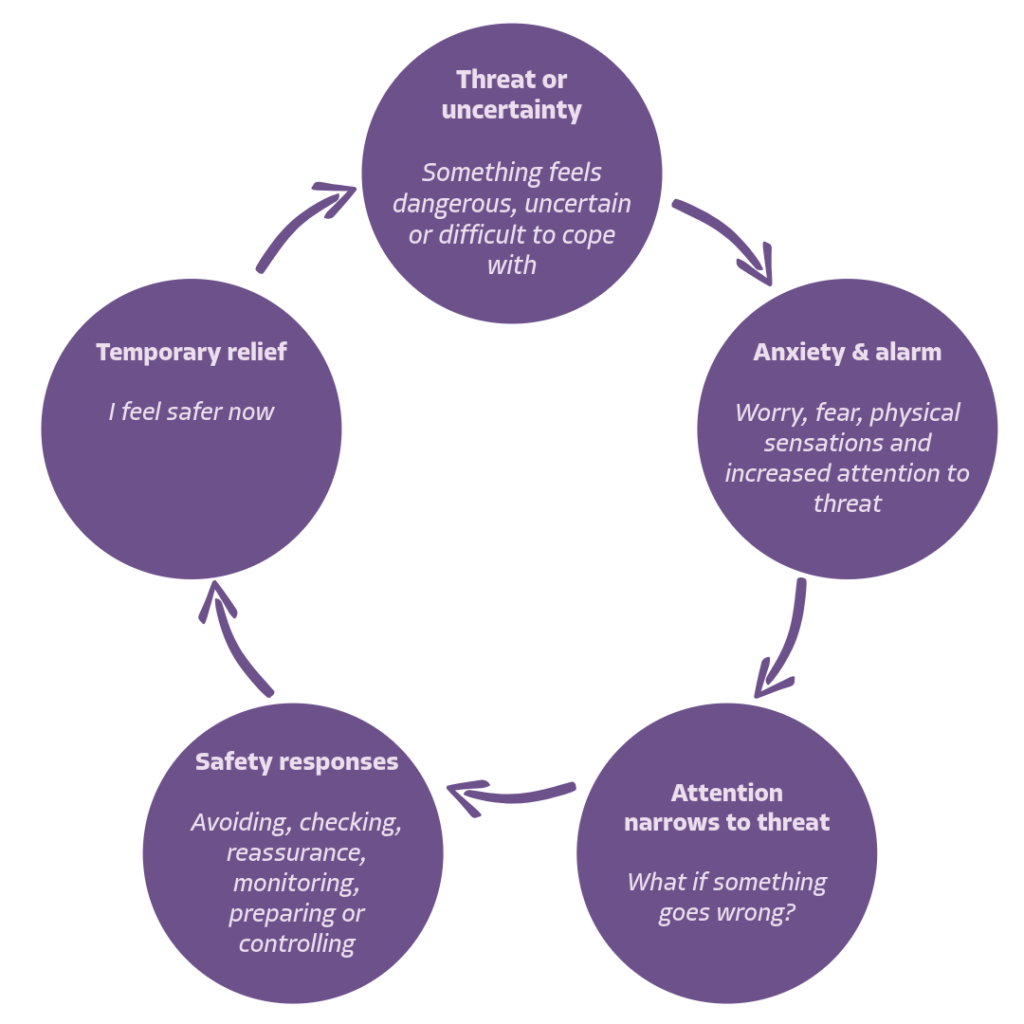
Anxiety isn’t usually maintained by one thought or one behaviour. It can become caught in cycles where threat predictions, physical sensations and attempts to create safety reinforce one another.
Avoidance may bring immediate relief. Reassurance can settle a worry. Checking may create temporary certainty. Extensive preparation can make a situation feel more manageable, whilst monitoring the body may seem like a sensible way of detecting danger early.
Each of these responses can make sense in the moment. The difficulty is that short-term relief can make the same response feel increasingly necessary the next time anxiety appears. These strategies can also make it harder for new learning to occur.
If someone only enters a situation after making it feel completely safe, they may never discover what happens without all the preparation. If reassurance repeatedly settles anxiety, the mind may become increasingly dependent on reassurance whenever uncertainty returns. If a sensation is constantly monitored, it can begin to feel increasingly important.
Over time, responses that originally helped someone feel safer can become conditions they believe they need in order to cope.
Effective therapy isn’t about removing every safety strategy or deliberately making life uncomfortable. It helps distinguish genuine protection, boundaries and accommodations from responses that have gradually become part of the anxiety cycle.
How Therapy Can Help
There is no single therapy that is right for every anxiety difficulty or every person. We begin by understanding what anxiety is responding to, what is maintaining it and what someone would like to become more able to do.
Depending on the formulation, Cognitive Behavioural Therapy (CBT) can provide an evidence-based framework for difficulties including panic disorder, health anxiety, social anxiety, generalised anxiety and specific phobias. Behavioural experiments and exposure-based approaches may be used where avoidance, anxious predictions or safety behaviours are maintaining fear.
Acceptance and Commitment Therapy (ACT) can help people develop greater flexibility around difficult thoughts, sensations and uncertainty, particularly when efforts to control internal experiences have themselves become restrictive.
Where anxiety is intertwined with shame, self-criticism, longstanding patterns, relationships or previous experiences, therapy may also thoughtfully draw on Compassion Focused Therapy (CFT), Schema Therapy, EMDR or Integrative Psychotherapy.
Integration doesn’t mean using everything at once. The formulation guides what we use, when and why. The aim isn’t to eliminate anxiety, but to help people develop enough flexibility that fear no longer needs to make so many decisions for them.
Explore Different Types of Anxiety & Fear
Anxiety can become organised around many different themes. These pages aren’t boxes you need to fit neatly within, and people often recognise experiences across several areas.
Generalised Anxiety & Worry
When worry moves across many areas of life and the mind feels continuously occupied with anticipating, planning or preventing what could go wrong.
Panic Attacks & Panic Disorder
When bodily sensations become frightening in themselves, creating fear of another panic attack and increasing monitoring, avoidance or attempts to prevent one.
Health Anxiety
When uncertainty about health becomes caught in cycles of symptom monitoring, checking, researching or reassurance-seeking.
Social Anxiety
When social situations become organised around fears of judgement, embarrassment, rejection or being seen negatively by other people.
Specific Phobias
Intense fear associated with particular objects, situations or experiences that can lead to avoidance and significant restriction.
Emetophobia
A persistent fear of vomiting, seeing somebody else vomit or situations associated with becoming unwell, which can affect eating, travel, relationships and everyday life.
Fear of Public Speaking & Performance
Anxiety linked to being observed, evaluated or expected to perform in front of other people.
Anxiety & Neurodivergence
Understanding how anxiety can intersect with sensory processing, masking, executive functioning, uncertainty, social experiences and environments that may not meet neurodivergent needs.
Common Misconceptions About Anxiety
“If I’m anxious, something must be wrong.”
Anxiety is an alarm system, not a verdict. It tells us that something has been interpreted as important or potentially threatening, but it doesn’t always tell us exactly what is happening or what we should do next.
“The goal is to get rid of anxiety.”
A life without anxiety isn’t realistic or necessarily desirable. Anxiety can be useful. Therapy is more often about helping anxiety become proportionate and less able to dictate your choices.
“I need to feel calm before I can do difficult things.”
Waiting for complete calm can gradually make anxiety more influential. Often, meaningful change involves discovering that you can do important things with some anxiety present.
“Avoidance is always bad.”
No. Avoidance can be sensible, protective or necessary. The question is whether it reflects genuine risk or need, or whether fear is increasingly restricting things you would otherwise want to do.
This distinction is especially important when sensory overwhelm, trauma or neurodivergence are involved.
“Reassurance is always helpful.”
Reassurance can be an important part of human relationships. Difficulties arise when reassurance becomes something we repeatedly need in order to settle the same uncertainty and the relief never lasts for long.
“Anxiety is just overthinking.”
Anxiety involves thoughts, emotions, attention, behaviour and the nervous system. For some people, bodily sensations or avoidance are much more prominent than conscious worry.
“If exposure makes me anxious, it isn’t working.”
Feeling anxiety during exposure doesn’t mean it has failed. The purpose isn’t necessarily to make fear disappear immediately, but to create new learning about what happens when you approach something without relying on the same protective responses.
“Being sensitive means I’m anxious.”
Not necessarily. Sensory sensitivity, emotional intensity and awareness of changes in the environment aren’t automatically symptoms of anxiety. Therapy should distinguish difference from disorder rather than trying to reduce every form of sensitivity.
“If anxiety has been there for years, it’s just part of my personality.”
Longstanding patterns can feel deeply familiar, but familiarity doesn’t necessarily make them fixed. Therapy can help you understand how those responses developed and create new ways of relating to situations that currently feel threatening.
Food For Thought
Feeling safe and being safe aren’t always the same thing. What might become possible if anxiety no longer had to be completely settled before life could move forward?
A Note from Agi
One of the things I value most about anxiety work is understanding what sits underneath the word “anxious.”
Two people can use exactly the same word whilst describing very different experiences. One person may fear bodily sensations, another may spend hours anticipating illness or rejection, whilst somebody else may be experiencing sensory overwhelm that has repeatedly been labelled anxiety. If we treat all of those experiences in exactly the same way, we risk trying to change something before we’ve properly understood it.
I also don’t think effective anxiety therapy is simply about becoming exceptionally skilled at calming down. Regulation can be helpful, but if someone begins believing they must feel calm before they can cope, calming down can itself become another condition for living.
For me, therapy is about helping people understand their alarm system, recognise what genuinely needs their attention and develop enough flexibility that anxiety can be present without automatically being in charge.
Frequently Asked Questions
How do I know if my anxiety is “bad enough” for therapy?
You don’t need to reach a particular threshold before seeking support. A useful question is how much anxiety is influencing your choices, relationships, work, sleep or ability to do the things that matter to you.
If a significant amount of energy is going into managing, preventing or recovering from anxiety, it may be worth exploring.
What if I don’t know which type of anxiety I have?
That’s completely okay. Anxiety presentations can overlap, and similar symptoms can arise through very different processes.
Assessment helps us understand what is happening rather than expecting you to diagnose yourself first.
Is anxiety always caused by irrational thoughts?
No. Anxiety can be influenced by previous experiences, learning, uncertainty, health, relationships, environment, sensory processing and many other factors.
Sometimes something genuinely difficult is happening. Therapy isn’t about labelling every concern irrational; it’s about understanding what response fits the situation.
Can anxiety cause physical symptoms?
Yes. Anxiety involves physiological systems designed to prepare us for threat, which can produce sensations such as a racing heart, dizziness, nausea, trembling, breathlessness or muscle tension.
At the same time, therapy shouldn’t automatically assume that every physical symptom is psychological.
Will I have to face my fears?
Approaching avoided situations can be an important part of evidence-based anxiety therapy, but this isn’t about suddenly forcing you into the most frightening situation imaginable.
Where exposure is appropriate, we’ll develop a clear rationale together and work collaboratively.
What if exposure has made me feel worse before?
Exposure can be unhelpful when it is poorly designed, overwhelming or completed whilst relying heavily on safety behaviours that prevent new learning.
We can explore what was previously tried, what the aim was and whether a different formulation or approach would make more sense.
How do I know whether I’m avoiding something because of anxiety or because I genuinely don’t want to do it?
This isn’t always obvious, and therapy isn’t about forcing yourself to do everything you’ve ever avoided.
We can explore whether the decision feels consistent with your values and needs or whether fear has gradually removed a choice that you would otherwise like to have.
How does neurodivergence affect anxiety?
Autism and ADHD can influence sensory processing, transitions, executive functioning, uncertainty, communication and social experiences. Neurodivergent people may also experience anxiety disorders like anyone else.
The important thing is not to automatically treat genuine sensory or environmental needs as fear that needs exposure.
What if I need reassurance from other people?
Seeking support is normal and healthy. Reassurance becomes more complicated when the same question needs answering repeatedly because certainty fades quickly.
Therapy can help distinguish supportive connection from reassurance that has become part of an anxiety or OCD cycle.
Is health anxiety the same as OCD?
They can overlap and sometimes look very similar, particularly when checking, reassurance and uncertainty are involved. However, they aren’t necessarily the same process.
Formulation helps us understand what is maintaining your particular experience rather than deciding solely from the surface behaviour.
Can trauma cause anxiety?
Traumatic experiences can certainly influence the way the nervous system responds to perceived threat, but not all anxiety is trauma-related.
Where trauma is relevant, we can integrate this into the formulation without assuming every anxious response originates from the past.
Can EMDR help with anxiety?
Sometimes. EMDR may be appropriate where particular distressing experiences continue to drive a present-day fear response.
Its use depends on your formulation and what we are trying to address rather than simply applying EMDR to anxiety as a category.
Can anxiety really change if I’ve had it most of my life?
Longstanding anxiety may take time to understand and change, particularly when avoidance and safety strategies have become woven into everyday life.
The aim isn’t to erase your history or become somebody who never feels fear. It’s to develop more options for responding so anxiety has less power over how you live.
Can therapy be delivered online?
Yes. Many psychological therapies can be delivered effectively online, depending on the individual and the type of therapy being offered.
I provide online therapy across the UK, as well as working internationally where appropriate and where professional and regulatory requirements allow. For people who prefer face-to-face therapy, I offer in-person appointments in Menai Bridge, Anglesey and Llandudno, Conwy, North Wales.
During the initial assessment, we can consider whether online or in-person therapy is the best fit and discuss any practical or clinical factors that may influence how therapy is delivered.
How Do We Start?
If anxiety or fear is taking up more space in your life than you want it to, you’re welcome to book a free 15-minute discovery call.
You don’t need to arrive knowing whether your experience is best described as generalised anxiety, panic, health anxiety, social anxiety, a phobia or something else. We’ll begin by understanding what makes you anxious, what your mind predicts, what happens in your body and how you’ve learned to respond when anxiety appears.
Together, we’ll develop a formulation that considers the wider picture, including avoidance, reassurance, safety behaviours, previous experiences, neurodivergence, sensory needs, relationships and any overlap with OCD or trauma.
The aim isn’t to teach you how to eliminate every anxious feeling. It’s to create enough freedom that anxiety no longer gets to decide the shape of your life.
If You Only Take One Thing Away…
Anxiety is a protective response, but protection can gradually become restriction. Recovery isn’t about never feeling anxious again; it’s about understanding what your anxiety is trying to do and building enough flexibility that fear no longer has to make so many decisions for you.