
Specialist evidence-based therapy for eating disorders and difficulties with food, eating and body image, helping people understand what is happening, what keeps it going and what meaningful recovery can look like.
Eating disorders are often reduced to food, weight or appearance, but people’s experiences are rarely that simple. Difficulties with eating can become intertwined with emotions, identity, relationships, perfectionism, self-worth, sensory experiences, trauma, neurodivergence and the different ways people have learned to cope.
For some people, restriction can create a temporary sense of control or predictability. For others, binge eating may offer relief from difficult emotions or develop within cycles of restriction and deprivation. Exercise, purging, body checking or increasingly rigid food rules may briefly reduce distress whilst gradually taking up more and more space.
Not all eating difficulties are driven by concerns about weight or shape. ARFID, for example, may involve sensory sensitivity, fear of consequences such as choking or vomiting, limited interest in eating, or a combination of these experiences. Two people may therefore appear to eat in very similar ways whilst what is happening underneath is completely different.
At Food For Thought Therapy, I don’t see eating-disorder behaviours as meaningless habits that simply need to be stopped. They develop and continue for reasons. At the same time, understanding alone is rarely enough. Recovery also involves creating new experiences and making practical changes to patterns that have become restrictive.
Therapy begins by understanding how the eating difficulty is operating for that particular person. Together, we’ll develop a shared formulation of what has shaped the difficulty, what keeps it going and what meaningful recovery might look like, before identifying the evidence-based approaches most likely to help.
Understanding Eating Disorders
Food and eating are part of everyday life, but with an eating disorder they can begin to carry much more significance. A meal, a change in routine, a body sensation or a particular food can start to feel important enough that it requires a response. The mind may begin asking:

The content can vary enormously. For some people, the difficulty centres around weight, shape or restriction. For others, it may involve binge eating, purging, sensory sensitivity, fear of choking or vomiting, limited interest in eating or increasingly rigid food rules. What often remains more consistent is the sense that something needs to be managed, controlled, avoided, compensated for or made safer before the person can move on.
Resolving one difficulty doesn’t necessarily end the process. A new rule may appear, another food becomes difficult, eating something unexpected can trigger guilt, or a behaviour that briefly brought relief begins to feel increasingly necessary. Eating disorders can therefore become less about one particular food or behaviour and increasingly about the patterns that begin organising eating, the body and everyday life.
How Eating Disorders Can Affect Everyday Life
Eating disorders can affect almost every area of life, and much of the difficulty may be invisible to other people. Someone can appear to be carrying on as usual whilst internally spending significant time planning, calculating, checking, negotiating or worrying about food, eating or the body.
People might notice:
- Restricting, eating less, delaying meals or avoiding particular foods.
- Following food rules, becoming increasingly rigid around what, when or how much to eat.
- Binge eating, experiencing episodes of eating accompanied by a sense of loss of control.
- Compensating, through vomiting, fasting, driven exercise or other behaviours.
- Checking, weighing, comparing or repeatedly examining the body.
- Avoiding, staying away from meals, restaurants, celebrations, travel or unfamiliar foods.
- Monitoring, paying close attention to hunger, fullness, body sensations, calories or changes in appearance.
- Feeling afraid of food, including fears involving weight gain, choking, vomiting, illness, textures or other consequences.
- Finding eating practically difficult, including planning, shopping, preparing food or recognising hunger and fullness.
- Organising life around eating, changing routines, relationships or opportunities because food or the body feels difficult to manage.
Eating disorders don’t have to look dramatic from the outside to take up an enormous amount of space internally. For some people, the most exhausting parts are the rules, calculations, fears and negotiations that nobody else can see.
What Keeps Eating Disorders Going?
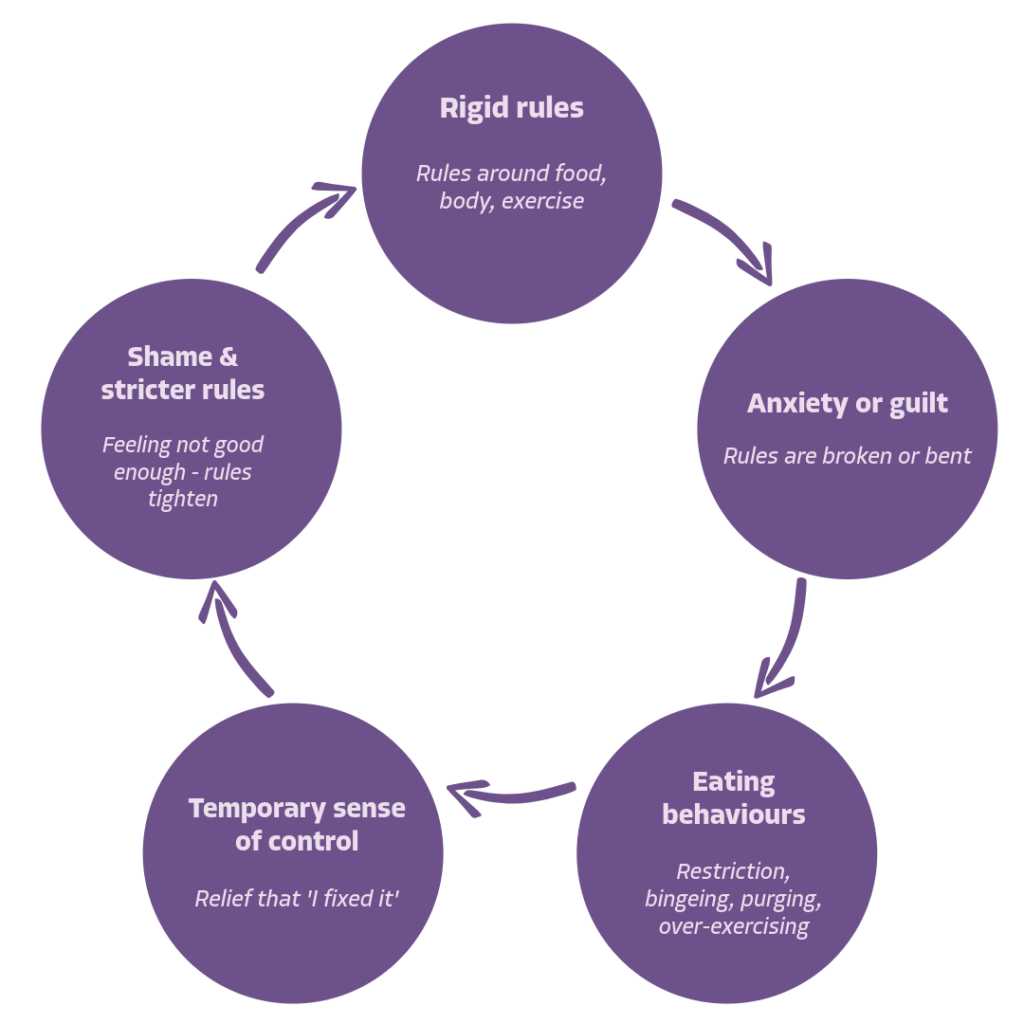
Eating disorders aren’t usually maintained by one behaviour or one cause. They can become caught in cycles where physical, emotional and behavioural processes reinforce one another.
Restriction may temporarily reduce anxiety or provide a sense of achievement. Binge eating may soothe emotional distress or emerge following restriction and biological deprivation. Purging can briefly reduce discomfort or guilt. Body checking may promise reassurance, whilst avoidance offers temporary relief from self-criticism. Exercise may regulate emotion or provide a sense of control. With ARFID, avoiding a food can immediately reduce fear or sensory distress.
Each of these responses can make sense in the moment. The difficulty is that short-term relief can make the same response feel increasingly necessary the next time something difficult appears.
The body can also become part of the cycle. Restriction and irregular eating may increase food preoccupation, emotional changes and difficulty concentrating. Restriction and binge eating can reinforce one another, whilst repeatedly avoiding feared or unfamiliar foods may make them feel increasingly difficult to approach.
Over time, patterns around food can begin to feel necessary rather than chosen, even when they are increasingly restricting someone’s life.
Effective therapy helps us understand these cycles whilst creating the practical, emotional and behavioural changes needed for something different to become possible.
How Therapy Can Help
There is no single therapy that is right for every eating disorder or every person. We begin by understanding what is happening around food and eating, what is maintaining the difficulty and what meaningful recovery would look like for that person.
Depending on the formulation, Enhanced Cognitive Behavioural Therapy (CBT-E) for Eating Disorders can provide a specialist framework for eating disorders including anorexia nervosa, bulimia nervosa and binge eating disorder, whilst Cognitive Behavioural Therapy for ARFID (CBT-AR) is specifically designed for ARFID.
Where eating difficulties are intertwined with shame, perfectionism, relationships, trauma, self-criticism or emotional regulation, therapy may also thoughtfully draw on Schema Therapy, EMDR, Compassion Focused Therapy (CFT), Acceptance and Commitment Therapy (ACT) or Integrative Psychotherapy.
Integration doesn’t mean using everything at once. The formulation guides what we use, when and why. The aim is therapy that is specialist enough to understand eating disorders whilst remaining responsive to the individual person experiencing one.
Explore Eating Disorders & Related Difficulties
Eating difficulties can take many forms, and experiences often overlap or change over time. These pages aren’t boxes you need to fit neatly within. They’re simply different ways of exploring what may be relevant to you.
Anorexia Nervosa (AN)
An eating disorder involving restriction alongside difficulties around eating, weight and shape that can increasingly influence self-worth, choices and everyday life.
Bulimia Nervosa (BN)
Recurrent episodes of binge eating alongside attempts to compensate through behaviours such as vomiting, restriction, fasting or driven exercise.
Binge Eating Disorder (BED)
Recurrent episodes of binge eating involving a sense of loss of control, often accompanied by distress, shame and complicated cycles around restriction and eating.
Avoidant/Restrictive Food Intake Disorder (ARFID)
Avoidance or restriction associated with sensory sensitivity, fear of aversive consequences and/or limited interest in eating rather than concerns about weight or shape.
Other Specified Feeding or Eating Disorder (OSFED)
Eating difficulties that cause meaningful distress or restriction but don’t fit neatly within another eating-disorder category.
Body Image Difficulties
When thoughts and feelings about your body increasingly influence self-worth, relationships, choices or how freely you’re able to participate in life.
Compulsive or Driven Exercise
When movement becomes organised around rules, compensation, guilt, anxiety or a feeling that exercise is something you have to do.
Emotional Eating
Exploring the relationship between food and emotion without assuming that eating in response to emotion is automatically a problem.
Chronic Dieting & Restrictive Eating
When repeated dieting, food rules or restriction create an increasingly difficult relationship with eating, even when a particular diagnosis doesn’t fit.
Orthorexic Patterns
When attempts to eat in a particular way become increasingly rigid, consuming or restrictive and begin interfering with flexibility, relationships or everyday life.
Eating Disorders & Neurodivergence
Understanding eating through a neurodivergent-affirming lens, including sensory processing, interoception, executive functioning, predictability, masking and regulation.
Eating Disorders & Trauma
Exploring how eating difficulties and traumatic experiences can intersect without assuming that trauma is the cause of every eating disorder.
Common Misconceptions About Eating Disorders
“You can tell whether somebody has an eating disorder by looking at them.”
You can’t. Eating difficulties occur across body sizes, and appearance alone tells us very little about somebody’s relationship with food, psychological distress or how much of their life has become organised around eating-disorder patterns.
“Eating disorders are just about wanting to be thin.”
Weight and shape concerns are central for some people, but eating disorders are much more complex than appearance alone. Food may become connected with emotions, perfectionism, identity, control, self-worth, relationships or previous experiences. ARFID isn’t driven by weight or shape concerns at all.
“If I’m eating, I can’t have an eating disorder.”
Eating disorders aren’t defined by whether somebody eats. People may continue eating whilst experiencing significant restriction, bingeing, purging, rigid food rules, driven exercise or enormous distress around food.
“ARFID is just picky eating.”
ARFID can involve significant difficulty eating because of sensory sensitivity, fear of consequences and/or limited interest in food. At the same time, having food preferences or a relatively small range of preferred foods doesn’t automatically mean someone has ARFID. Context and impact matter.
“A limited diet in an autistic person must be ARFID.”
Not necessarily. Neurodivergent people may have genuine sensory preferences, routines or executive-functioning needs around food that support regulation rather than representing pathology. Therapy needs to understand what the eating pattern is doing rather than judging it by how it looks.
“Binge eating means I lack self-control.”
Binge eating isn’t simply a failure of willpower. Restriction, biological deprivation, emotion, learned coping patterns, environmental cues and other processes may all contribute. Responding with more shame or restriction can sometimes strengthen the very cycle someone is trying to escape.
“Recovery means learning to love my body.”
Not necessarily. Recovery doesn’t require permanent body confidence or loving everything about how you look. For many people, it means body image has less power to determine self-worth, choices and whether they feel permitted to participate in life.
“If I understand why I developed an eating disorder, it should disappear.”
Understanding matters enormously, but insight alone doesn’t necessarily change an established eating disorder cycle. Recovery often involves both making sense of why patterns developed and creating new experiences around eating, emotion, the body and everyday life.
“Recovery should look the same for everyone.”
There is no single version of recovery. Somebody recovering from anorexia nervosa may need something very different from somebody with BED or ARFID, and neurodivergence, culture, identity, sensory needs, trauma and personal values may all influence what meaningful recovery looks like.
Food For Thought
What might become possible if food, eating and your body took up less space, not because you became better at controlling them, but because they no longer needed to carry so much responsibility in your life?
A Note from Agi
One of the things I value most about eating disorder work is getting to know the person whose life has gradually become overshadowed by food, eating, body image, exercise or fear.
By the time many people arrive in therapy, they’ve heard countless messages about what they should eat, how they should feel about their body or why they ought to simply stop particular behaviours. I’m much more interested in understanding why those patterns came to make sense, whilst recognising that recovery also asks us to create something different.
Recovery can bring mixed feelings. Someone can desperately want greater freedom whilst another part of them feels frightened about changing their eating, routines, body or coping strategies. I don’t see that ambivalence as resistance. It tells us something important about what the eating disorder may have been doing for that person.
For neurodivergent people, recovery also shouldn’t become another demand to appear more neurotypical. Sensory needs, safe foods, routines and accommodations can genuinely support wellbeing. Our job is to distinguish what supports someone from what has become restrictive, rather than assuming everything different needs changing.
For me, recovery isn’t about replacing one rigid set of rules with another. It’s about gradually creating more room for nourishment, relationships, spontaneity, identity, emotion, rest and all the other parts of life that can become difficult to hear when food and eating have become so loud.
Frequently Asked Questions
How do I know if my relationship with food has become a problem?
There isn’t one behaviour, body size or level of difficulty that answers this. A useful place to start is considering how much mental and practical space food, eating, exercise or body image occupies and whether those patterns are restricting your choices, relationships or everyday life.
You don’t need to diagnose yourself before coming to therapy. We can begin by understanding what is happening.
Do I need to know which eating disorder I have before getting in touch?
No. Eating difficulties can overlap, change over time or not fit neatly within one category. Assessment is there to help us understand your experience and consider what therapeutic approach makes most sense.
What if my eating difficulties aren’t about weight or body image?
That’s entirely possible. Eating may be difficult because of sensory sensitivity, fear of consequences such as choking or vomiting, limited interest in food or other experiences.
Where ARFID may be relevant, the important question is what is driving the restriction, rather than assuming it has the same meaning as restriction within another eating disorder.
What if I only eat a small range of foods?
A limited range can happen for many reasons and isn’t automatically problematic. Particular foods and routines may genuinely support sensory regulation, predictability or make eating more manageable.
We would look at the wider picture, including distress, flexibility, nutrition and everyday impact, rather than assuming that maximum variety should always be the goal.
What if I’m scared of choking, vomiting or becoming ill from food?
Fear of aversive consequences can contribute to restrictive eating and may appear within ARFID. Similar fears can also arise within emetophobia, OCD and other difficulties.
Understanding what process is underneath the avoidance helps us choose an approach that fits rather than treating every fear around eating in the same way.
What if I binge but don’t compensate afterwards?
Binge eating can occur without regular purging or other compensatory behaviours. Binge Eating Disorder may be relevant for some people, whilst binge episodes can also occur within other patterns.
Therapy explores what is contributing to the bingeing, including restriction, deprivation, emotion, stress, habits and learned coping patterns, rather than treating it simply as a problem of control.
What if part of me wants recovery and another part doesn’t?
Mixed feelings about recovery are common. Eating disorder behaviours can be exhausting and restrictive whilst simultaneously providing predictability, control, emotional relief, identity or something else that feels important.
Therapy can make room for both sides rather than expecting you to feel completely certain about recovery before you’re allowed to begin.
Will therapy just tell me what to eat?
No. Eating-disorder therapy is much broader than giving somebody another set of food rules.
Depending on your formulation, we may work with eating patterns, fears, body image, emotions, perfectionism, shame, self-criticism, sensory experiences, relationships, avoidance and previous learning. At the same time, practical changes around eating are often an important part of recovery where these patterns are keeping the difficulty going.
What if I’m neurodivergent?
Neurodivergence is considered throughout formulation and therapy. Autism and ADHD can influence sensory processing, interoception, executive functioning, appetite awareness, predictability and the practical demands of planning, preparing and eating food.
The aim isn’t to make your eating look more neurotypical. We’ll distinguish adaptations that genuinely support you from patterns that are restricting the life you want to live.
Can eating disorders and trauma be connected?
They can be, although trauma isn’t the explanation for every eating disorder. For some people, eating-disorder patterns may become connected with experiences of safety, control, shame, the body, relationships or emotion.
Where trauma or distressing memories are part of your individual formulation, approaches such as EMDR may be thoughtfully integrated alongside specialist eating-disorder work rather than assuming that processing trauma alone will resolve the eating difficulties.
Can Schema Therapy help with eating disorders?
For some people, yes. Schema Therapy can help us understand long-standing beliefs and emotional patterns involving worth, failure, perfectionism, shame, relationships or unmet emotional needs that may interact with an eating disorder.
It isn’t a replacement for specialist eating-disorder treatment where that is needed, but it can offer a valuable additional lens when deeper patterns are maintaining difficulties.
I’ve had eating-disorder therapy before and it didn’t help. Does that mean therapy won’t work for me?
No single experience of therapy tells us what all future therapy will be like. Previous treatment can help us understand what fitted, what didn’t, what may have been overlooked and whether a different formulation or approach might make the work more relevant now.
Sometimes neurodivergence, trauma, shame, sensory experiences or mental processes weren’t sufficiently considered. Sometimes the therapeutic model simply wasn’t the right fit at that point in someone’s life.
What does recovery actually look like?
There isn’t one version of recovery. It doesn’t require loving every part of your body, enjoying every food or never having another difficult day.
For many people, recovery means greater flexibility and choice, less reliance on eating disorder behaviours and more space for relationships, interests, spontaneity and everyday life. For somebody with ARFID, it may involve making eating less frightening or effortful, improving flexibility or developing a range of foods that genuinely works for their needs.
Can therapy be delivered online?
Yes. Many psychological therapies can be delivered effectively online, depending on the individual and the type of therapy being offered.
I provide online therapy across the UK, as well as working internationally where appropriate and where professional and regulatory requirements allow. For people who prefer face-to-face therapy, I offer in-person appointments in Menai Bridge, Anglesey and Llandudno, Conwy, North Wales.
During the initial assessment, we can consider whether online or in-person therapy is the best fit and discuss any practical or clinical factors that may influence how therapy is delivered.
How Do We Start?
If food, eating, exercise or thoughts about the body are taking up more space in someone’s life than they want them to, they’re welcome to book a free 15-minute discovery call.
People don’t need to arrive knowing exactly which diagnosis fits or which therapy they need. We’ll begin by understanding what eating currently looks like, what feels difficult, what the patterns may be doing and what continues to keep them going.
From there, we’ll develop a shared formulation that considers the wider picture, including eating patterns, emotions, body image where relevant, relationships, sensory experiences, neurodivergence, perfectionism, shame, trauma and previous experiences. We’ll then consider which therapeutic approach is most likely to help.
Recovery doesn’t have to mean becoming a different person or developing a perfect relationship with food or the body. It’s about creating greater freedom, flexibility and space for the parts of life that eating difficulties may have gradually pushed aside.
If You Only Take One Thing Away…
Eating disorders can look very different, but what happens around food is only part of the story. Recovery means understanding what keeps the difficulty going, changing the patterns that have become restrictive and gradually making more room for life beyond the eating disorder.