
Evidence-based therapy. Specialist expertise. Continual learning.
Choosing a therapist is about much more than finding someone with the right qualifications. You want to know that the person you’re working with has the knowledge, experience and clinical judgement to understand your individual experiences, whilst offering therapy that is grounded in the best available evidence.
Throughout my career, I have continued developing my knowledge because I don’t believe there is one therapeutic approach that fits every person or every difficulty. Whilst research helps us understand what works, meaningful therapy also requires curiosity, collaboration and an appreciation that every person’s experiences have developed within the unique context of their life.
Everything I do is guided by one simple belief: People make sense in context. That philosophy sits at the heart of every assessment, formulation and therapy session I provide.
Why Clients Choose to Work With Me

My Professional Journey
My interest in psychology has always been both professional and personal. My own experiences first made me curious about how we make sense of what happens to us, why we develop particular ways of coping and what allows things to begin to change. That curiosity eventually became a career, but it still shapes the way I approach therapy today.
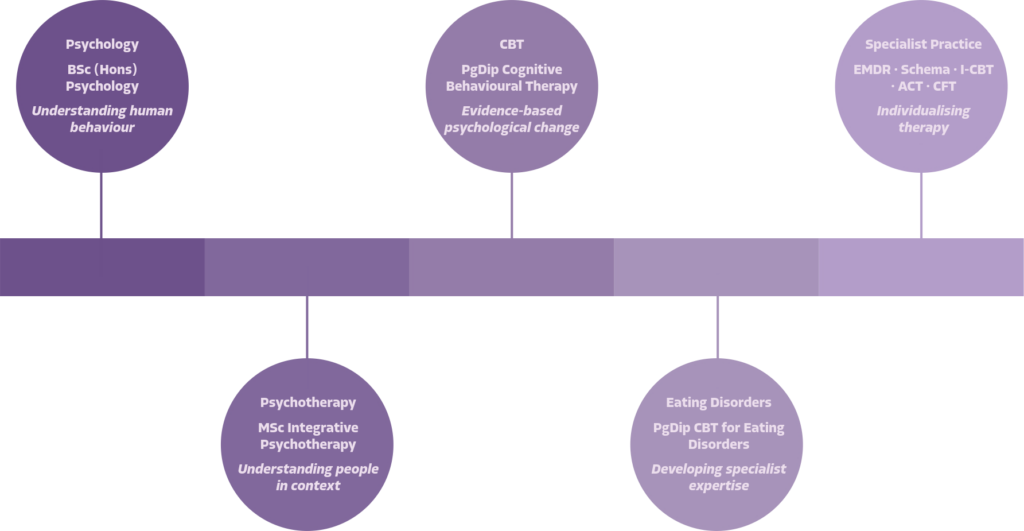
My training has taken me from psychology and integrative psychotherapy through to specialist Cognitive Behavioural Therapy (CBT), eating disorders and a range of evidence-based approaches including EMDR, Schema Therapy, At other times, Acceptance & Commitment Therapy (ACT), Compassion Focused Therapy (CFT), or Inference-based. Along the way, I have worked across NHS and specialist mental health services, with my clinical interests increasingly developing around eating disorders, OCD, trauma and more complex psychological difficulties.
Despite the different models and qualifications, one principle connects them: The better we understand what is happening and why, the more thoughtfully we can decide what might help.
Areas of Specialist Expertise
Beyond the Therapy Room
My work extends beyond individual therapy. Alongside clinical practice, I have been involved in leadership, teaching, clinical supervision, professional training and writing for professional publications. I value these different parts of my work because they keep me connected to the wider psychological community and continually encourage me to reflect on how evidence translates into thoughtful, effective clinical practice.
Leadership
I currently serve as Chair of the BABCP Eating Disorders Special Interest Group, contributing to professional education, collaboration and the development of evidence-based practice within the eating disorder field.
Being involved in the wider professional community gives me opportunities to contribute to conversations about how eating disorder treatment continues to develop, whilst learning from clinicians working across different services and disciplines.
Teaching & Training
Alongside therapy, I have been involved in teaching, professional training and supporting clinicians developing specialist CBT skills.
My work with the University of Sheffield has included supporting the development of clinicians undertaking specialist training, alongside contributing my clinical experience in CBT and eating disorders.
Teaching is something I particularly value because it requires us to do more than simply know a therapeutic model. We have to think carefully about why we do what we do, how the evidence translates into real clinical work and where therapy needs to remain flexible enough to meet the person in front of us.
Clinical Supervision
I am a qualified clinical supervisor and provide supervision to therapists developing their practice, including those working towards professional accreditation or developing specialist skills.
Supervision creates space to think beyond individual techniques, to consider formulation, therapeutic relationships, complexity, clinical decision-making and how evidence-based approaches can be applied thoughtfully rather than mechanically.
Publications & Professional Writing
I have also been published in a number of professional journals and publications, contributing to wider discussions within psychological therapy and clinical practice.
Writing has become another way for me to engage with the profession: taking clinical ideas, evidence and experiences from practice and making them accessible and useful to other clinicians.
Continuing to Learn
Psychological therapy continues to evolve, and I believe our practice should evolve with it. Alongside regular clinical supervision, I continue to undertake specialist training, attend professional conferences and keep up to date with developments across the areas in which I work. Recent areas of professional development include:
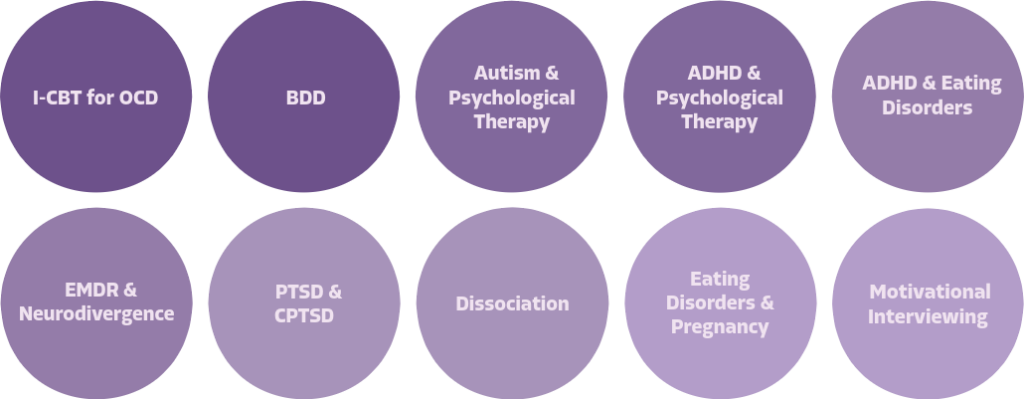
For me, professional development isn’t about collecting certificates. It’s about making sure the therapy I offer continues to evolve alongside the evidence and the people I work with.
Qualifications & Professional Training
My core professional qualifications provide the foundation for my work, alongside specialist postgraduate training and continued professional development across the areas in which I practise.
Academic & Clinical Qualifications
- BSc (Hons) Psychology
- MSc Integrative Psychotherapy
- Postgraduate Diploma in Cognitive Behavioural Therapy (CBT)
- Postgraduate Diploma in Cognitive Behavioural Therapy for Eating Disorders (CBT-ED)
- Clinical Supervision Training
Advanced Therapeutic Training
- EMDR Practitioner Training
- Schema Therapy
- Inference-Based CBT (I-CBT)
- Acceptance and Commitment Therapy (ACT)
- Compassion Focused Therapy (CFT)
- Additional specialist training across OCD, eating disorders, ARFID, BDD, trauma and neurodivergence
Professional Memberships
- Accredited Member: British Association for Behavioural and Cognitive Psychotherapies (BABCP)
- Graduate Member: British Psychological Society (BPS)
- Member: British Association for Counselling and Psychotherapy (BACP)
- Member: EMDR UK

Food For Thought
Training teaches us how to understand psychological difficulties. People teach us what those difficulties actually feel like to live with. Effective therapy needs both.
A Personal Reflection
Looking back, no single qualification or therapy model has shaped the therapist I am today.
It has been the combination of training, clinical experience and working alongside people whose lives rarely fit neatly into textbooks or diagnostic categories. Again and again, this has reinforced something that sits at the heart of my practice: people make much more sense when we understand their experiences in context.
I bring clinical experience, specialist knowledge and evidence based therapy. You bring an understanding of your own life and experiences that I could never learn from a textbook.
Therapy is where we bring those two kinds of knowledge together, developing a shared understanding of what is happening, what may be keeping things difficult and what might help. For me, that is where meaningful therapy begins.
Ready to Take the Next Step?
You don’t need to know which therapy you need before getting in touch.
We can start with a free 15-minute discovery call, giving you an opportunity to tell me a little about what has brought you to therapy, ask any questions and get a sense of whether working together feels like the right fit.